
 New Horizons
 Project Management Academy
 Six Sigma Online
 TCM Security
 TRACOM
 Velopi
 Watermark Learning
New Horizons
Project Management Academy
Six Sigma Online
TCM Security
TRACOM
Velopi
Watermark Learning
Watermark Learning
New Horizons
Project Management Academy
Six Sigma Online
TCM Security
TRACOM
Velopi
Watermark Learning

Earning Project Management Institute (PMI)'s Project Management Professional (PMP)® certification is an important step in your project management career. It is a challenging process, but having a PMP certification can open career opportunities leading to increased earning potential.
PMI publishes A Guide to the Project Management Body of Knowledge (PMBOK® Guide), an important global standard for project management. The PMP Examination Content Outline defines the domains, tasks, and knowledge covered on the PMP certification exam.
Project Management Academy has everything you need to understand the PMP exam requirements and the process for applying for the PMP Certification so that you can start advancing your career today!


Ultimate Guide to PMP Certification
Get this complete roadmap and successfully navigate the PMP Certification process.
The Project Management Professional (PMP) certification, offered by the globally recognized Project Management Institute (PMI), serves as a comprehensive validation of your knowledge, skills, and experience in project management. It demonstrates your ability to effectively lead and direct projects, while ensuring adherence to project management best practices, processes, methodologies, and professional ethics upheld by PMI.
To earn your PMP certification, you must:
Once you earn your PMP certification, you must earn 60 Professional Development Units (PDUs) during each three-year renewal cycle to maintain your credential.
Project Management Institute requires that you meet specific education, project leadership experience, and training requirements before you are eligible to take the PMP certification exam. The PMP certification application requires qualifying experience leading projects and 35 hours of project management education or training. PMI will review your application and notify you when you are eligible to schedule the PMP exam.
The information below provides an overview of the education, project leadership experience, and training requirements for PMP certification applicants. All qualifying project leadership experience must have occurred within the 10 years before submitting your PMP application. Overlapping months of experience cannot be counted more than once.
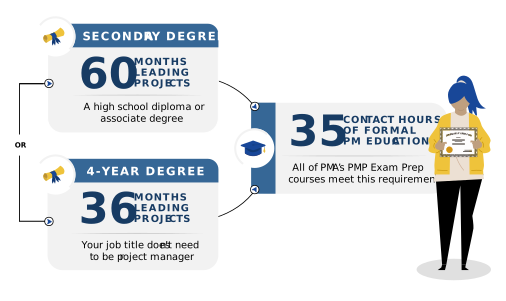
High School Diploma, GED, Secondary School Certificate, or Global Equivalent
Associate Degree, Higher Certificate, Technical Qualification, Vocational Qualification, or Global Equivalent
Bachelor's Degree or Higher from a Recognized Institution
Bachelor's Degree or Postgraduate Degree from a PMI Global Accreditation Center Accredited Program
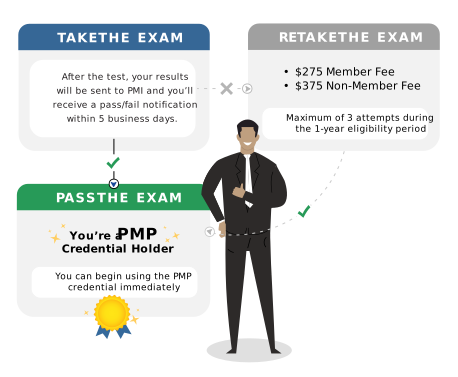
PMI administers the PMP certification exam. To apply to take the exam, you must first create a PMI account to use for logging into the PMI website. Next, submit your completed PMP certification exam application with the required documentation on the PMI website. After PMI approves your application, you will receive the information to schedule your exam.
To prepare, review the PMP Exam Content Outline and familiarize yourself with the PMP certification exam format. We offer a number of study materials and practice exams in our PMP Certification Training course to help you get ready.
The application process for the PMP certification exam is as follows:


These articles provides more information on the value of a PMP certification:
For additional information, you may refer to PMI directly:

The cost to take the PMP certification exam is $655 for nonmembers. PMI members pay a discounted exam fee of $405. An individual PMI membership costs $164 per year, bringing the combined membership and exam cost to $569. This saves you $86 on the exam process and gives you access to additional PMI member benefits. PMI membership is optional and is not required to apply for or take the PMP exam.
PMI requires 35 contact hours to sit for the PMP exam. Project Management Academy's PMP exam prep course has been approved by PMI to issue the 35 contact hours. Upon completing the required PMI Post-Class Survey (instructions are provided in-class and in your PMA Learning Portal), your 35 hours will also populate in your PMI profile to streamline your application process for the PMP Certification. For extra assurance, we will provide you with a certificate of completion at the end of the course that you can submit to PMI if you get audited.
You can apply for the PMP exam before attending the course, provided you have already completed the required 35 hours of PM training needed to sit for the exam. Most students wait until the live course is completed, at which time they will have earned the necessary 35 hours to apply for the exam, and that's what we generally advise students to do. However, circumstances sometimes require students to get certified within a short timeframe.
As a word of caution, we generally do not recommend taking the PMP certification exam immediately after completing the course. While it certainly can be done, it requires extra preparation prior to the live course. We recommend allowing yourself at least 1 week of study after the live course to ensure that you are fully prepared.
PMP certification holders are required to earn a minimum of 60 PDUs over the course of 3 years to meet the Continuing Certification Requirements (CCR) to maintain your credential.
For Non-PMI Members, the cost to renew your PMP Certification is $150 per 3 year cycle. For PMI members, the cost is discounted to $60.
From an annual project manager survey report, PMI collected self-reported data from 32,000 Project Managers across 42 countries. Data showed that those with a PMP® certification earn 22% more than those without it. The PMI states that in the USA., the median salary for Project Managers is $ 116,000.
Once you have earned the Project Management Professional certification, you must maintain a specific number of PDUs in PMI-determined categories and pay the renewal cycle fee to remain certified. PMI PDU requirements are in the PMI CCR Handbook. Submit your PDU claims via the PMI CCR online portal with the best practice of submitting as soon as possible after completing an activity.
The entire PMP certification process includes the time to complete the application, the 5 business days the PMI uses to review your application, the exam prep work, and taking the exam. Generally speaking, starting the application process to receiving your certification can take about 6 months.
In a survey of 100 PMP certification holders asked how long they studied for their exams, the answers ranged from a week to 6 months! The conclusion was that for most project managers, it takes about 2 months of 2 - 3 hours of daily study to prepare for the PMP certification exam. To plan your PMP certification prep, keep in mind that you will need time to complete your application and you need time to study, before you actually take the exam.
Popular Courses
Corporate Training
Contact Us
 Mon - Fri | 8:00 AM - 6:00 PM EST
Connect With Us


PMI, PMBOK, PMP, CAPM, PMI-ACP, PMI-RMP, PMI-SP, PMI-PBA, The PMI TALENT TRIANGLE and the PMI Talent Triangle logo, and the PMI Authorized Training Partner logo are registered marks of the Project Management Institute, Inc. | PMI ATP Provider ID #3348 | ITIL® is a registered trademark of AXELOS Limited. The Swirl logo™ is a trademark of AXELOS Limited | IIBA®, BABOK® Guide and Business Analysis Body of Knowledge® are registered trademarks owned by International Institute of Business Analysis. CBAP®, CCBA®, IIBA®-AAC, IIBA®-CBDA, and ECBA™ are registered certification marks owned by International Institute of Business Analysis. | BRMP® is a registered trademark of Business Relationship Management Institute.
 Login
Login

 Influencing Without Authority
 (877) 637-0450
 contact@projectmanagementacademy.net
 New Horizons
 Project Management Academy
 Velopi
 Six Sigma Online
 TCM Security
 TRACOM
 Watermark Learning