

 New Horizons
 Project Management Academy
 Six Sigma Online
 TCM Security
 TRACOM
 Velopi
 Watermark Learning
 Login
Login



Key Takeaways
- Outputs Break Under Pressure: Fixed deliverables collapse when conditions shift.
- Outcomes Stabilize Direction: Measurable impact guides decisions across departments.
- Governance Must Strengthen: Uncertain work requires a disciplined structure.
- Decision Quality Drives Results: PMs manage trade-offs, not task lists.
- Process Maturity Scales Execution: Strong frameworks steady multi-team initiatives.
Building Plans for Measurable Impact
Projects begin with scope, timelines, budgets, and defined deliverables. On paper, everything appears controlled. In reality, control rarely lasts. Yet complex initiatives still fall short when conditions shift faster than plans can adjust, especially when departments coordinate around shared goals.
Multi-department efforts feel this strain first. Marketing drives launch targets, IT configures systems, and operations prepares rollout procedures. Each group delivers on commitments, yet shared metrics stall because completion doesn’t guarantee improvement.
At XentinelWave, a modernization program spanned marketing, IT, operations, and finance. Milestones were met, but revenue lift and customer adoption stalled. The issue wasn’t effort or competence. Planning focused on outputs in work that required outcome stability, and this tension defines much of modern project complexity.
Most organizations plan around what they can control. Strong organizations plan around what must improve. That shift changes how decisions are framed, how governance is structured, and how project leaders operate. Understanding this difference requires rethinking what most teams are trained to protect.
Moving Beyond Deliverable-Driven Results
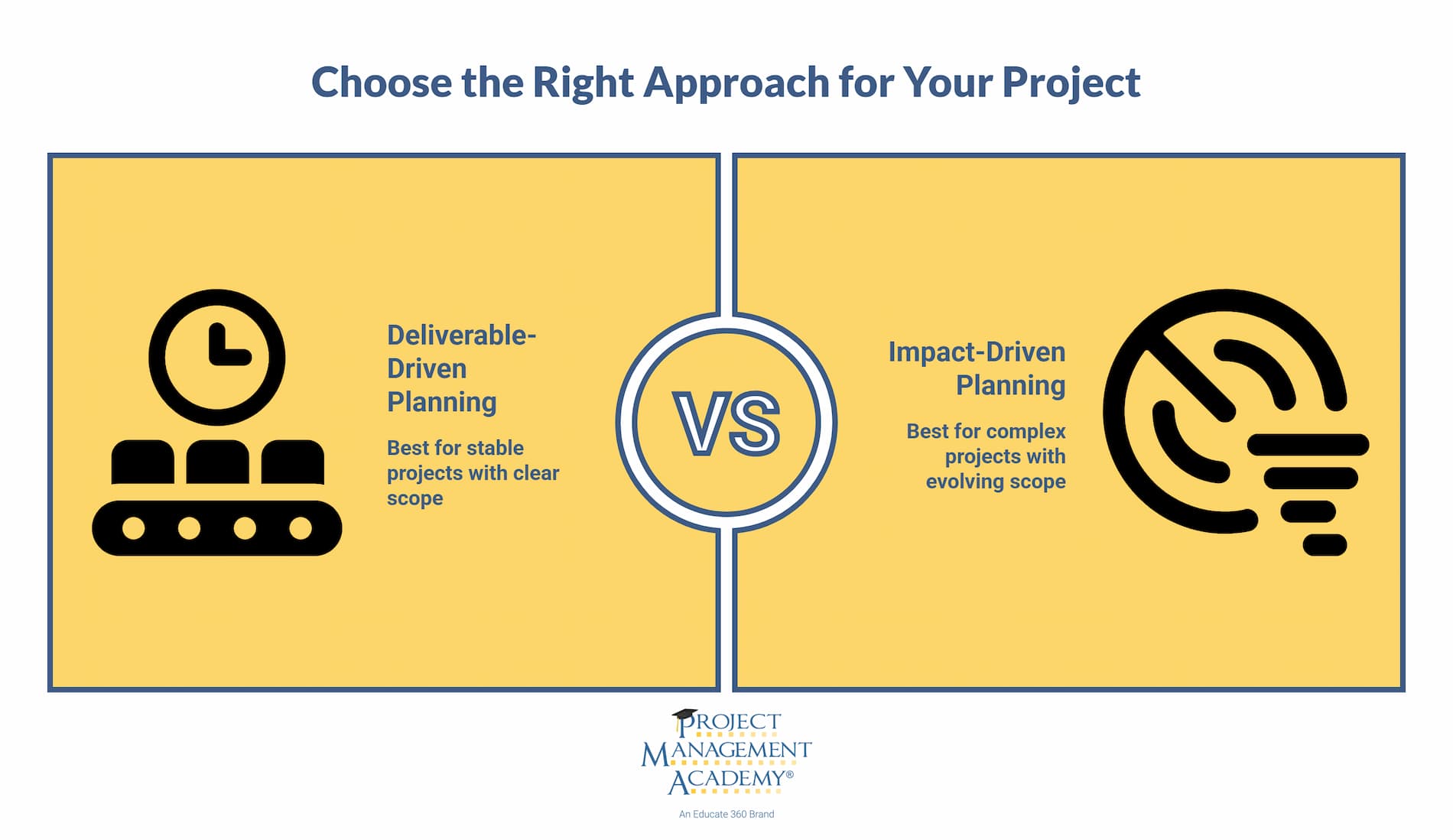
Most organizations train teams to protect scope and deliver on time because predictability feels safe. Deliverable-based planning rewards milestones and strict change control because they create order. In stable conditions, it works. Problems surface when assumptions shift but the plan doesn’t.
Common Output Planning Priorities
- Scope Definition: Set boundaries and document requirements early.
- Work Breakdown Structure: Break work into assigned, trackable pieces.
- Milestone Tracking: Measure progress through scheduled checkpoints.
- Completion Metrics: Define success as percent complete.
- Change Control: Route deviations through formal review.
This structure creates visible progress and clean reporting. Leaders see movement, and teams see order. The weakness appears when new information shifts direction and energy moves toward defending scope instead of protecting impact.
Most project plans assume predictability, even when reality rarely cooperates. Infrastructure and regulatory work benefit from tight scope management and clear boundaries. Complex initiatives operate differently, where innovation introduces new dependencies, technology shifts constraints, and teams juggle competing definitions of success.
At XentinelWave, departments defended assigned outputs during reviews. Marketing protected campaign scope, IT protected platform features, and operations protected timelines. Shared metrics showed little movement despite visible completion.
Outputs create activity, but activity doesn’t ensure progress. Cross-functional work exposes this gap quickly because performance depends on shared impact, not isolated delivery. To move forward, planning must shift from protecting deliverables to defining measurable improvement.
Anchoring Work to Measurable Impact
Once planning shifts toward measurable improvement, outcome-based planning may sound simple, yet many teams misunderstand it. Some treat outcomes as vague ambitions, while others assume flexible scope means relaxed accountability. In practice, it demands sharper definition and tighter measurement so the target stays stable as execution evolves.
The difference becomes clear when outputs and outcomes sit side by side, especially when performance stalls despite visible completion.
Outputs Versus Outcomes
| Output | Outcome |
| Launch new portal | Increase customer self-service adoption by 30 percent |
| Implement CRM | Reduce sales cycle time by 15 percent |
| Deploy AI chatbot | Improve first-response resolution by 20 percent |
| Roll out training | Reduce onboarding time by 20 percent |
An output marks completion. An outcome proves improvement. One focuses on delivery, while the other focuses on impact. This distinction shifts the entire planning conversation.
When teams anchor work to outcomes, deliverables become tools rather than endpoints. Scope still matters, but it serves the metric. Trade-offs become easier because the performance target stays constant despite feature changes or vendor shifts. The question shifts from “Did we finish?” to “Did performance improve?”
This shift also requires discipline. Teams begin with baseline performance and define a target within a set time horizon. Measurement moves from afterthought to design constraint. Without clarity, outcome language loses strength and drifts back into aspiration.
Outcome language without precision creates confusion because success stays undefined. When discipline anchors measurement, alignment improves as performance becomes visible. Many organizations struggle here, and the gap often appears in how structure supports decisions.
Building Structure for Confident Decisions
As uncertainty increases, some organizations loosen structure in the name of flexibility. In practice, uncertain work requires stronger decision discipline. The shift isn’t from control to freedom. It’s from protecting tasks to protecting measurable impact across departments.
Outcome-based planning builds that discipline across three pillars.
Pillar One: Outcome Definition Discipline
Clear outcomes anchor alignment. Teams define baseline performance, set a measurable target within a time horizon, and assign one accountable owner.
Strong outcome definition requires:
- Baseline Clarity: Establish current performance before acting.
- Target Definition: Define measurable improvement within a set time frame.
- Ownership Alignment: Assign one accountable outcome owner.
Without this foundation, cross-functional initiatives drift and shared metrics lose force.
Pillar Two: Decision Guardrails
Once outcomes are defined, teams protect them with explicit guardrails. Uncertain work requires predefined pivot criteria and clear boundaries around what may change.
Effective guardrails include:
- Defined Constants: Clarify what must remain stable.
- Pivot Triggers: Identify conditions that require adjustment.
- Authority Clarity: Define who can authorize change.
Guardrails reduce reactive debate and keep flexibility disciplined rather than chaotic.
Pillar Three: Adaptive Scope Design
With outcomes and guardrails in place, scope can flex without losing stability. Deliverables support impact instead of replacing it.
Adaptive scope design includes:
- Modular Deliverables: Break work into flexible components.
- Early Validation: Test assumptions before scale.
- Progress-Based Funding: Align investment to measurable movement.
At XentinelWave, pivot criteria were undefined across departments, and escalations occurred late in review cycles. Clear guardrails would have preserved alignment before tensions surfaced.
Stronger governance doesn’t slow uncertain work. It stabilizes it by protecting decision quality under pressure. But structure alone isn’t enough. Someone must sustain that discipline across departments, especially when tension rises and trade-offs become difficult.
From Coordination to Outcome Leadership
Uncertain, cross-functional work changes what organizations expect from project managers. Schedule oversight still matters, yet complex initiatives demand more than task coordination. Impact must stay visible across departments even as solutions evolve.
In uncertain work, PMs need broader capabilities to protect impact consistently.
Outcome Steward Responsibilities
- Outcome Translation: Connect business goals to measurable targets.
- Decision Framing: Present trade-offs in impact terms across departments.
- Assumption Tracking: Surface weak assumptions before they become surprises.
- Pivot Governance: Keep pivot rules and authority clear.
- Stakeholder Alignment: Maintain shared understanding of progress and priorities.
These responsibilities improve decision quality across departments. The goal isn’t more reporting layers but fewer surprises and clearer trade-offs tied to measurable performance.
In uncertain work, the PM stops protecting tasks and protects decision quality. Strategy turns into defined targets, assumptions surface early, and trade-offs gain business framing. At XentinelWave, schedules stayed controlled, yet outcome coordination lacked consistency, revealing the need for stronger governance across departments.
Managing timelines keeps work organized. Protecting decision quality keeps it relevant. Over time, sustained discipline under pressure earns stakeholder trust.
Strengthening Trust Through Decision Discipline
Decision discipline shapes more than execution. Uncertainty creates tension at every level of an organization. Executives worry about cost growth without visible return, department leaders worry about losing control over commitments, and teams worry about shifting expectations without clear direction. Trust depends on how well leaders manage this pressure with clarity.
Stakeholders tend to trust uncertainty more when progress remains visible and predictable.
Trust Builders During Volatility
- Shared Metrics: Anchor departments to a focused set of outcome indicators.
- Clear Trade-Offs: Define what shifts, what stays fixed, and why.
- Early Signal Reviews: Watch early indicators before issues grow.
- Decision Cadence: Maintain a steady review rhythm with clear escalation rules.
- Plain Language Updates: Report impact movement rather than activity volume.
These practices reduce guesswork by keeping performance visible as scope evolves. Departments shift conversations from activity to results because impact remains measurable. Consistent decision rules lower tension and reinforce credibility under pressure.
Trust strengthens when leaders make ambiguity legible instead of hiding it. Clear criteria reduce escalation and quiet territorial debate. Even strong communication can’t compensate for weak discipline, making sustained outcome focus under pressure essential.
Sustaining Outcome Focus as Conditions Evolve
Outcome-based planning strengthens alignment when backed by discipline. Without structure, flexibility turns into drift. Multi-department environments expose weak ownership and vague metrics quickly, and credibility erodes when follow-through fades.
Outcome-based planning fails in familiar ways when discipline slips.
Common Misapplications to Watch
- Vague Outcomes: Skip baselines and targets, then argue over results later.
- Shared Ownership: Spread accountability and stall decisions.
- Endless Iteration: Test without committing to convergence.
- Unclear Pivot Rights: Leave authority undefined and escalate late.
- Poor Framing: Present change as chaos instead of structured trade-offs.
These patterns rarely appear all at once. They surface gradually under pressure, weakening clarity and slowing decisions. Clear ownership and defined limits prevent flexibility from becoming confusion. Once discipline stabilizes at the project level, the real test becomes scaling it across the portfolio.
Scaling Outcome Discipline
Individual project capability improves isolated initiatives. Organizational reliability requires scaling capability across teams consistently. Reliable execution across departments follows when adoption becomes standard practice, since alignment rarely happens by accident. When outcome thinking becomes standard practice, funding decisions sharpen and prioritization gains clarity.
Outcome-based planning proves its durability once it spreads beyond a single initiative.
Portfolio-Level Gains
- Funding Discipline: Invest based on measurable progress.
- Faster Stops: End weak initiatives earlier.
- Priority Clarity: Compare initiatives using shared targets.
- Cross-Team Alignment: Keep departments focused on shared performance targets.
- Value Governance: Shift oversight from schedules to impact.
These gains appear when outcome thinking shapes portfolio reviews and executive conversations. Leaders gain clearer visibility into what to continue, adjust, or stop, and departments align around measurable performance rather than protective scope.
Consistent execution builds stability under pressure, and collective capability sustains it. Stability never comes from isolated expertise. It comes from shared standards and disciplined governance, which ultimately requires structured development.
Investing in Outcome-Centered Leadership
Experience builds judgment, yet complex cross-functional work requires shared structure. Without consistent frameworks, departments interpret impact, risk, and accountability differently, and those differences surface under pressure. Execution slows not from lack of effort, but from lack of shared governance language.
Structured development becomes essential when teams must operate with shared standards across the organization and make decisions under pressure.
Capability Gaps Certification Can Address
- Impact Blind Spots: Finish deliverables while performance measures stay flat.
- Risk Translation Gaps: Struggle to explain execution risk in business terms.
- Weak Governance Design: Run reviews without clear pivot triggers or authority.
- Inconsistent Standards: Use different approaches across departments.
- Decision Drift: Delay hard calls until timelines force them.
These gaps appear in organizations with strong intent but uneven structure. Teams complete the work, yet results remain inconsistent or difficult to measure. A shared framework establishes common rules for planning, measurement, and decision rights, bringing consistency across teams.
Experience shapes judgment, yet structured frameworks create consistent discipline across teams. When outcome fluency becomes embedded in organizational capability, impact stays protected even as plans evolve and conditions shift.
Protect the Impact, Not the Plan
Uncertain work will continue to reshape assumptions. Dependencies will surface across departments without warning, and deliverables will evolve as information changes. Through all of it, the performance target stays constant, regardless of how execution evolves.
Six to twelve months after adopting outcome-based planning, measurable shifts emerge. Escalations decline because pivot criteria are defined in advance. Cross-functional misalignment decreases as shared metrics guide decisions. Performance indicators reflect sustained movement rather than isolated milestone completion.
Disciplined process frameworks enable this stability. Flexibility without discipline invites confusion. Discipline aligned with measurable impact produces resilient performance.
Project Management Academy equips project professionals with structured frameworks for complex work. Our PMP and advanced process training programs strengthen governance discipline, outcome alignment, and decision architecture, enabling teams to deliver measurable performance gains even under uncertainty.
Related Project Management Training:


 Influencing Without Authority
 (877) 637-0450
 contact@projectmanagementacademy.net
 Mon - Fri | 8:00 AM - 6:00 PM EST


 New Horizons
 Project Management Academy
 Velopi
 Six Sigma Online
 TCM Security
 TRACOM
 Watermark Learning