

 New Horizons
 Project Management Academy
 Six Sigma Online
 TCM Security
 TRACOM
 Velopi
 Watermark Learning
 Login
Login



Why Business Strategies Fail Without Project Managers
A leadership team rolls out AI tools across the enterprise to boost productivity and reduce costs. Press releases go out, teams are told to “start using the tech,” and expectations soar. But six months later, adoption lags, training is incomplete, and confusion spreads. Leadership asks, “What happened?”
The reason is simple: strategic execution was never built into the plan. Project management was left out of the discussion.
Many organizations focus on vision but neglect the structure needed to turn ideas into measurable outcomes. Leadership and innovation cannot succeed without a delivery plan. When execution is missing, trust erodes, opportunities are lost, and competitors gain ground.
This blog shows how project managers can change that by delivering plans and shaping them. It explores why strategies fail, how PMs strengthen them, and what it takes to earn a trusted voice in executive decision-making.
Common Strategy Execution Mistakes and How Project Managers Fix Them
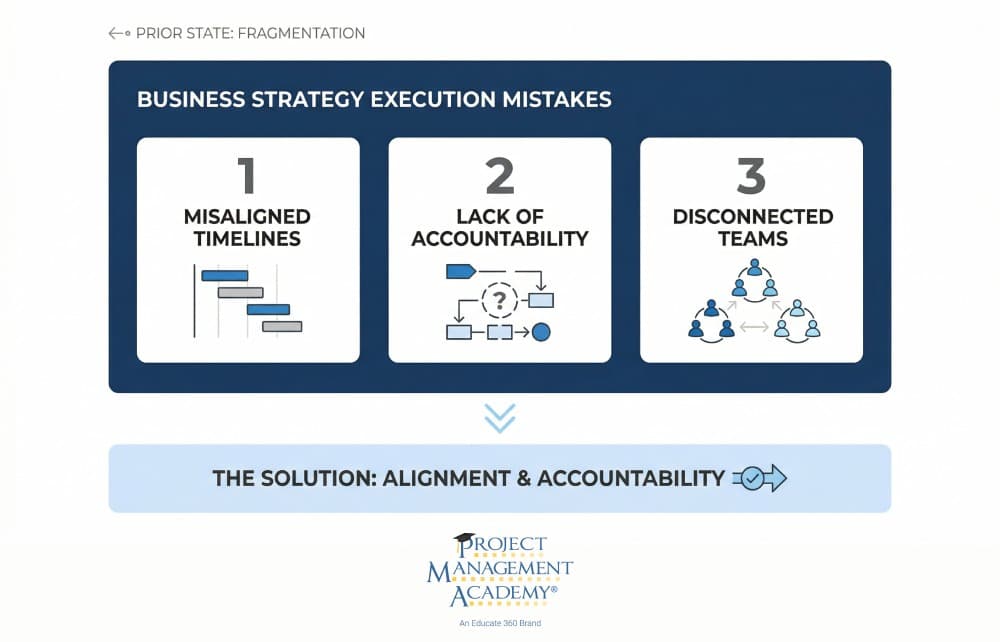
Even strong strategies fail when execution isn’t part of the plan. Without accountability, realistic timelines, and coordinated delivery, initiatives stall and lose momentum. Project managers bridge this gap, turning strategy into concrete, achievable action.
Common examples include:
- Manufacturing: launching new lines without aligned procurement, leaving equipment idle
- Healthcare: implementing digital records without training, causing bottlenecks and frustration
- Startups: rushing product launches for investors, overwhelming engineering, and support
- Government agencies: delaying policy rollouts when IT, training, and compliance are siloed
- Professional services: stalling onboarding when marketing, sales, and operations work on different timelines
Strategies fail without alignment, accountability, or a clear delivery framework. Involving PMs early helps fill those gaps by guiding execution, managing trade-offs, and keeping teams on track. That is where the real transformation begins.
How Project Managers Turn Strategy Into Results
Good strategies fail without ownership. PMs turn high-level goals into action by aligning teams, managing risks and dependencies, coordinating stakeholders, and keeping priorities clear for everyone.
Project managers do this by:
- Creating realistic timelines based on resources and risks
- Mapping dependencies so critical tasks happen in sequence
- Coordinating cross-department work to prevent duplication
- Tracking progress and reporting it in business terms
Consider a global retailer that launched IT upgrades before training customer service teams. Complaints rose, app adoption stalled, and confusion followed. A project manager could have connected these workstreams and prevented the disruption.
Strong execution is just one part of the equation. Project managers also play a key role in shaping strategy before delivery even begins.
How Project Managers Strengthen Strategic Planning
Project managers don’t just execute plans; they help shape them by asking questions that test feasibility, uncover risks, and ensure strategies align with operational reality. This involvement reduces the chance of mid-course corrections and missed targets.
They challenge assumptions by asking questions like:
- Feasibility: Can it be done with the current budget, staffing, and time?
- Dependencies: Which deliverables must come first?
- Risks: What could derail the plan, and what backups exist?
- Scenarios: What if the market, regulations, or priorities change?
- Alignment: Does it support OKRs or other strategic measures?
- Organizational readiness: Are stakeholders engaged, and is the organization prepared?
Microsoft’s shift to a cloud-first model succeeded by embedding execution into strategy. Project managers coordinated across Azure, Office 365, and development teams, aligning technical milestones with market goals to maintain speed and cohesion.
This example shows the value of involving PMs early in strategic planning. To change the pattern, we need to understand why they’re often left out.
Why Project Managers Are Often Excluded from Strategic Planning
Despite their value, PMs are still excluded from many strategy conversations.
The leading causes include:
- PMs are seen as tactical or middle management, not strategic partners
- Limited fluency in executive metrics such as ROI or customer lifetime value
- Silos separating planners from implementers
- Cultural bias toward quick action over long-term planning
Common executive objections:
- “Strategy is too high-level for details” → Early PM input prevents costly corrections.
- “PMs slow things down” → PMs speed delivery by removing obstacles early.
- “We have consultants” → Consultants guide, PMs sustain execution and knowledge.
A software company promised a six-month overhaul of its customer portal. Still, PMs brought in late found dependencies that doubled the timeline. Trust eroded. Early PM involvement could have set realistic expectations and avoided reputational damage.
Overcoming this requires shifting how organizations view project management in strategic planning. PMs must be positioned as strategic partners, and both PMs and executives must take responsibility for making that shift happen.
How to Make Project Management a Strategic Advantage
Elevating PMs to strategic partners takes commitment from both sides. PMs must prove their value, and executives must involve them early, recognizing project management in strategic planning as essential.
Actions PMs can take:
- Translating project progress into metrics that executives value, such as ROI, OKRs, or customer impact scores
- Presenting updates in terms of outcomes delivered, not just tasks completed
- Flagging delivery risks before they affect schedules or budgets
- Linking every project directly to strategic objectives
Actions Executives can take:
- Inviting PMs into early-stage strategy discussions
- Treating execution as a core part of strategy
- Providing leadership training so PMs can operate at a strategic level
- Creating career paths from project delivery into strategy and portfolio leadership
Quick wins:
- Add a PM to a strategy session
- Have a PM review a recent project post-mortem for missed opportunities
- Pair a PM with a senior leader to co-lead a cross-functional workshop
These actions quickly build trust and visibility, laying the groundwork for PMs to shape strategy from the start. When PMs are involved early, the benefits ripple across the organization, from faster delivery cycles to higher adoption rates.
What Early PM Involvement Achieves in Strategic Execution
Involving PMs early turns ideas into achievable, well-planned strategies. This is where project management in strategic planning delivers its greatest value, turning vision into strategic execution from the very beginning.
Key benefits include:
- Delivering digital transformation in manageable, phased rollouts
- Prioritizing portfolios by capacity and business value
- Gaining visibility into resources before commitments are made
- Spotting dependencies early and addressing them
- Avoiding costly last-minute pivots by keeping strategies on track
Early PM engagement shortens delivery cycles, cuts cost overruns, and boosts adoption rates by aligning training and support with launch schedules.
Amazon’s “Working Backwards” method is a prime example. Teams start with a mock press release and FAQ that outline the product’s features, benefits, and challenges. PMs then plan delivery around that vision, keeping departments aligned and launches true to strategy.
Full integration requires leaders to commit and PMs to advocate for their role in strategy. The more PMs prove their value in shaping outcomes, the closer organizations move to operating at their highest potential. However, getting there requires a partnership built on action.
Building Strong Strategic Partnerships and Overcoming Resistance
Building strategic partnerships starts with taking deliberate steps and showing visible results. Organizations can begin by:
In the next 30 days:
- Inviting PMs to strategic planning sessions
- Requesting feasibility reviews for active initiatives
- Pairing PMs with high-profile projects to deliver quick wins
In the next 6 months:
- Establishing a visible role or title for strategic project leadership
- Providing leadership training to help PMs contribute at a higher level
- Giving PMs access to market and business strategy discussions
- Having PMs lead cross-functional planning workshops
Long term:
- Rewarding PMs for measurable business impact
- Promoting PMs into roles with direct influence on strategy
- Embedding PM practices into every stage of strategic planning
- Tracking and share gains in speed, cost, satisfaction, and fewer delays or overruns
For PMs: Don’t wait for an invitation. Strengthen business acumen, align with leadership priorities, and frame your work in terms that speak to executive goals.
This shift only happens when PMs and leaders both act. Strategy and execution must align from day one.
Top Leadership Skills for Project Managers to Become Strategic Partners
To earn a place in executive strategy discussions, project managers need more than scheduling expertise and risk tracking. They must build leadership skills that allow them to influence, align, and inspire at every level of the organization. The most valuable skills include:
- Strategic Thinking: Link projects to long-term goals and set priorities accordingly.
- Executive Communication: Translate complex updates into clear, business-focused language.
- Stakeholder Influence: Build trust, manage expectations, and secure buy-in.
- Change Leadership: Guide teams and stakeholders through changes.
- Business Acumen: Use financial, operational, and market data to guide decisions.
These skills help PMs move from execution to strategy. With strong leadership and technical expertise, they become trusted advisors who earn a seat at the executive table and help shape what comes next.
How Project Managers Turn Strategic Vision Into Measurable Results
Bold strategies inspire, but without execution, they remain aspirations. Project managers bring the discipline, visibility, and accountability needed to execute bold strategies.
If you want to move from tactical delivery to strategic influence, the right training makes all the difference.
Project Management Academy gives PMs the tools to deliver results and influence decisions. Watermark Learning builds leadership skills to complement that training. Together, they help PMs turn vision into outcomes and earn a place in strategy discussions.
Take the lead. Explore our full catalog of project management and leadership courses. Gain the skills, confidence, and influence to earn your place at the table with Project Management Academy and Watermark Learning.
Recommended Training:


 Influencing Without Authority
 (877) 637-0450
 contact@projectmanagementacademy.net
 Mon - Fri | 8:00 AM - 6:00 PM EST


 New Horizons
 Project Management Academy
 Velopi
 Six Sigma Online
 TCM Security
 TRACOM
 Watermark Learning