

 New Horizons
 Project Management Academy
 Six Sigma Online
 TCM Security
 TRACOM
 Velopi
 Watermark Learning
 Login
Login



Key Takeaways
- Proactive Planning Matters: Early risk identification reduces rework and strengthens stakeholder confidence.
- Structure Builds Trust: Clear frameworks protect budgets, schedules, and team morale.
- Continuous Monitoring Wins: Regular risk tracking keeps teams adaptive and aligned.
- Accountability Is Essential: Defined risk owners drive follow-through and control.
- Culture Drives Resilience: When awareness becomes habit, teams face uncertainty with confidence.
The Risk That Was “Unlikely”
Every project hides uncertainty, no matter how well it’s planned. When those surprises surface, such as a vendor failure or missed dependency, they remind teams that risk was always there. These moments often lead to the same reflection: “We didn’t see that coming.” Risk management isn’t about predicting the future; it’s about building the discipline to prepare for it.
At SentinelWave, a growing firm, the moment came six weeks into a major rollout. Their analytics vendor vanished overnight, breaking data feeds and alarming the executive sponsor. Leadership stabilized operations quickly, but the disruption exposed a larger gap: risk planning was missing.
The team began noticing the same issues repeating across projects. Risk discussions focused on reaction instead of preparation. They realized that effective risk management is less about predicting every outcome and more about readiness. Without a clear framework, even capable leaders and advanced tools struggle to stay aligned on what matters most.
This article explores how project managers can build foresight, strengthen processes, and turn uncertainty into control. Whether you manage large programs or small initiatives, applying core risk management principles turns challenges into opportunities for more confident delivery.
Keep reading to learn how a structured approach can help you anticipate risks, make better decisions, and lead with clarity.
Beyond the Buzzword: What Risk Management Really Means in Practice
Risk is any uncertainty that could hinder a project’s success or objectives. Risk management helps teams spot those possibilities early, analyze their impact, and plan how to respond. It’s not a checklist you complete once, but a steady habit that builds foresight and trust across every project.
PMI’s Pulse of the Profession found that projects that use active risk management are 14 times more likely to achieve their goals and avoid major setbacks. It’s a reminder that a little structure and preparation can make the difference between scrambling and staying on course.
During a company-wide project review, the PMO Director noted a familiar issue. “We were great at reacting but not anticipating,” she said. The group agreed that without a shared framework, too much depended on individuals. They planned a simple process to discuss risks early in each project.
By formalizing risk management, teams build a reliable process that strengthens how they plan, adapt, and communicate.
What Strong Risk Management Delivers:
- Resilience: Projects can adapt quickly to change.
- Efficiency: Rework and lost effort are minimized.
- Confidence: Stakeholders see control and preparedness.
- Credibility: Leaders trust teams to manage uncertainty strategically.
Building this awareness helps teams stay focused on what matters most before problems escalate. It turns risk management from theory into practice and sets the stage for understanding why projects often fail without it.
When Risk Goes Unchecked: How Projects Fall Apart
When teams overlook risk, small issues often snowball into major setbacks. Missed deadlines, budget strain, and eroding confidence follow quickly. Without structure, leaders are left reacting instead of steering projects with purpose.
When teams ignore potential risks, the results are predictable:
- Missed deadlines due to unplanned rework
- Overstretched budgets from reactive decisions
- Eroded confidence across leadership and delivery teams
As the discussion turned to past projects, the CIO recalled how teams handled setbacks. “Every surprise became an emergency,” she said. The group agreed that problems surfaced too late and decided to add risk reviews early so issues could be addressed before plans suffered.
Skipping risk planning does not remove uncertainty, it simply postpones it. When surprises appear, they often cost more and limit choices. A solid plan may not prevent every problem, but it helps teams respond faster and protect results when challenges arise.
As organizations mature, managing project risks shapes overall agility. Tracking risks across efforts helps leaders identify patterns, such as coordination gaps or resource strain, and use those insights to improve performance.
A clear, disciplined risk framework helps leaders forecast impact, communicate early, and make sound choices. It transforms reaction into control and builds accountability across teams. With this foundation, the next step is creating a structure that keeps risk management consistent.
The Risk Management Blueprint Every Project Manager Needs
Successful project managers never leave risk to chance. They start by identifying threats and opportunities that could affect scope, cost, or quality. Simple tools like brainstorming and lessons-learned sessions make risks visible early enough to act on them.
This approach follows established frameworks such as PMBOK® and ISO 31000, which define risk management as a continuous, organization-wide process. SentinelWave’s leaders saw that risk cannot sit apart from governance or performance. It must grow with them.
As the discussion turned to process, the Project Manager admitted their risk reviews were often skipped. “We assumed everyone was watching for problems, but that meant no one owned them,” he said. The team agreed that each project should begin with a short session to identify key risks and assign owners.
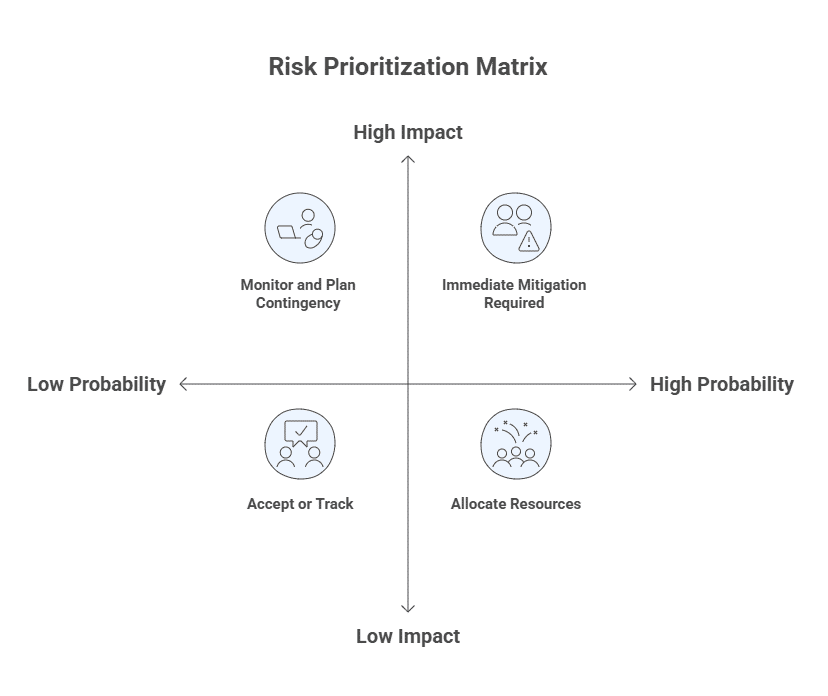
A few minutes later, the Operations Director added, “We need a simple visual system, so risks don’t get buried in spreadsheets.” The group discussed creating a color-coded matrix to make priorities more visible during team standups and to keep the most critical risks in focus.
The Core Steps of Effective Risk Management
1. Identify Risks
- Define potential issues: List anything that could affect project success.
- Gather insights: Use brainstorming, interviews, and past project data.
- Capture details: Record each risk’s likelihood, impact, and owner in a draft register.
2. Analyze and Prioritize
- Assess severity: Use a risk matrix to evaluate likelihood and impact.
- Focus attention: Address the risks that matter most.
- Document outcomes: Record priority rankings and rationale in the risk register.
3. Develop Response Plans
- Select strategy: Choose to avoid, mitigate, transfer, or accept each significant risk.
- Assign accountability: Define owners, triggers, and review intervals.
- Reduce exposure: Aim to lower the likelihood or impact of each risk.
4. Integrate and Monitor
- Build into workflow: Include risk tracking in regular routines.
- Stay current: Review and update as priorities shift.
- Monitor progress: Have each owner track indicators and report updates.
5. Communicate and Report
- Promote openness: Make risk discussion a leadership habit, not paperwork.
- Share updates: Include risk status in reports and meetings.
- Keep it active: Treat the risk register as a living guide that evolves as the project progresses.
Together, these five steps create a rhythm of planning, review, and communication that keeps projects on track. With the process in place, the next step is choosing the right tools to make risk management easier, faster, and more consistent across teams.
Essential Tools for Streamlining Risk Management
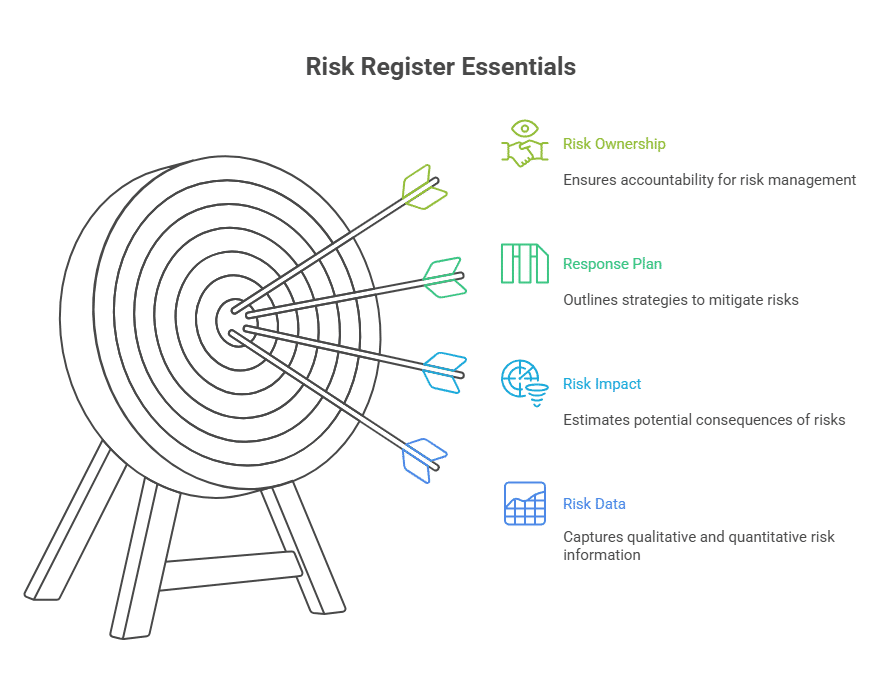
The right tools turn processes into daily practice. A consistent toolkit helps teams capture, track, and share risks clearly. Templates like registers, matrices, and dashboards add structure to discussions and help teams measure exposure and report with confidence.
A consistent risk management toolkit typically includes:
- Risk Register Template: Captures likelihood, impact, and ownership details
- Risk Matrix: Ranks priority levels for decision-making
- Pre-Mortem Worksheet: Identifies vulnerabilities before execution
- Lessons-Learned Log: Documents past risks and outcomes for reference
- Dashboard Report: Provides quick executive-level visibility
When the team reviewed their risk files, the PMO Lead noted an issue. “Everyone tracks risks differently, so we lack a shared view,” she said. The group agreed to pilot a single, simple template and gather feedback before wider use.
Over time, archived risk data becomes a powerful learning asset. Trends from past projects can highlight which mitigation strategies worked best or which types of risks recur across portfolios. Embedding those insights into planning documents turns experience into institutional intelligence.
Used consistently, these tools build confidence, traceability, and a common language for managing uncertainty. Once teams grow comfortable with them, the challenge becomes sustaining use and avoiding the pitfalls that make risk practices fade over time.
Top Risk Management Mistakes (and How to Avoid Them)
Even strong projects stumble when risk management becomes a checkbox exercise. Teams start with enthusiasm, but momentum fades once planning ends. The challenge isn’t finding risks; it’s keeping the discipline to review and act on them consistently.
Common pitfalls often include:
- Treating risk management as a one-time activity
- Ignoring positive or opportunity-based risks
- Assigning vague or shared ownership
- Allowing risk registers to go stale mid-project
Behavioral biases also distort how teams see risk. Overconfidence and optimism can create blind spots even in structured settings. Recognizing these biases helps teams stay objective when judging threats and opportunities.
Later in the review, the QA Manager raised a common issue. “We checked the risk box at kickoff and never looked again,” he said. The group saw that risk reviews often became formalities. To fix that, they added short risk check-ins at each sprint review to keep discussions on track.
Strong discipline keeps teams from drifting and makes risk management feel real, not routine. Lasting consistency comes from culture as much as structure. When people stay aware day to day, risk management becomes less of a task and more of a habit.
From Process to Culture: Making Risk Management a Habit
Mature risk management is as much about culture as it is about process. Teams that share responsibility for risk spot issues earlier and communicate more openly. When people feel safe raising concerns, the organization gains real foresight. Over time, that shared awareness becomes a lasting habit.
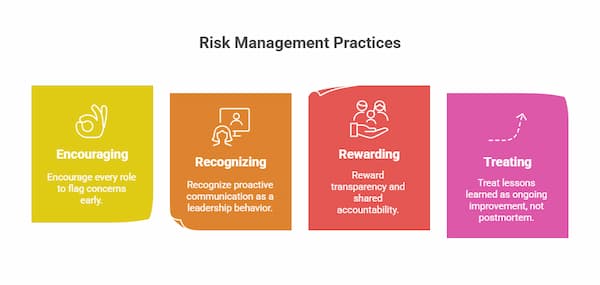
Building a team-wide habit of risk awareness means:
- Encouraging every role to flag concerns early
- Recognizing proactive communication as a leadership behavior
- Rewarding transparency and shared accountability
- Treating lessons learned as ongoing improvement, not postmortem
Leaders shape this culture. When they are open about uncertainty, share lessons, and ask questions, teams follow their lead. Visible accountability turns risk management from compliance into leadership.
As the meeting ended, the HR Director spoke about team culture. “If people do not feel safe raising concerns, we will never see the full picture,” she said. The group agreed that safety mattered as much as process and planned to reward early risk reporting.
Over time, the focus shifts from managing crises to preventing them. Openness gives teams confidence to spot issues early and act quickly. When everyone treats risk management as part of their job, resilience grows and carries into every project.
Turning Chaos Into Control
Effective risk management is more than a process, it’s a mindset that brings clarity to uncertainty and focus to decision-making. When teams pair leadership with discipline and open communication, they move from reacting to anticipating. This shift turns risk management into a foundation for control and confidence.
Six months later, SentinelWave showed real progress. Missed deadlines dropped, costs stabilized, and team confidence grew. A once reactive culture had become one defined by focus and foresight. Risk management was now their foundation for control amid uncertainty.
Whether your team is battling hidden risks or project surprises that seem to appear overnight, it’s never too late to regain control. Thousands of professionals have strengthened their foresight and confidence through Project Management Academy’s PMP® certification and advanced courses.
Don’t let unmanaged risks derail your next project. Join the most trusted name in project management training and lead with structure, clarity, and control.

 Influencing Without Authority
 (877) 637-0450
 contact@projectmanagementacademy.net
 Mon - Fri | 8:00 AM - 6:00 PM EST


 New Horizons
 Project Management Academy
 Velopi
 Six Sigma Online
 TCM Security
 TRACOM
 Watermark Learning