
 New Horizons
 Project Management Academy
 Six Sigma Online
 TCM Security
 TRACOM
 Velopi
 Watermark Learning
 Login
Login



Quick question: Your risk register shows everything’s green, but something feels off about your risk management approach. Do you need:
- A risk review to check if you’re tracking the right things
- A risk audit to verify you’re actually doing what you planned
- Both, but you’re not sure when to use which
If you picked C, you’re in good company. Most project managers know these tools matter, they just don’t know why they’re different or when each one saves the day. If you’re a student studying for the PMP exam, this confusion can turn a straightforward question into a coin flip that costs you precious points. Here’s how to finally nail the difference and use each tool exactly when your project needs it most.

Get Your Comprehensive Guide to Risk Management
Learn how to manage risk in every project.
Risk Audit and Risk Review
The risk audit is focused on ensuring the plan for managing risk is happening, while the risk review is about ensuring all the appropriate actions have been taken for all identified risks in addition to looking forward to any new or emerging risk/s. Both the risk audit and the risk review fit within the Risk Management Plan and are part of the tools, processes, and documentation recommended by the Project Management Institute (PMI).
| Risk | An uncertain event or condition that, if it occurs, has a positive or negative effect on one or more project objectives. (Source: https://www.pmi.org/pmbok-guide-standards/lexicon) |
| Risk Management Plan | A component of the project, program, or portfolio management plan that describes how risk management activities will be structured and performed. (Source: https://www.pmi.org/pmbok-guide-standards/lexicon) |
Risk Audit
Just as an audit for any financial system or software system is a line-by-line review of each process step and its outcome, so is a risk audit for a project. When preparing for the PMP certification exam, know that the risk audit reviews all risk management policies, guidelines, risk mitigation strategies, and outcomes of risk management activities.
Risk Audit Definition
Project managers should have defined risks, analysis results, responses, and mitigation results within the risk management work. That data is used to conduct a risk audit.
| Risk Audit | Examination and documentation of the effectiveness of risk responses in dealing with identified risk and their root causes and the effectiveness of the risk management process. (Source: https://www.projectmanagement.com/contentPages/wiki.cfm?ID=346698&thisPageURL=/wikis/346698/Risk-audit#_=_) |
When to use a Risk Audit
The size of the project will determine the frequency of risk audits (small projects may only need one audit conducted vs a large or extended project needing a series of risk audits conducted). A thorough risk audit shows how each project process performs, especially risk management work. As shared on the PMI’s project management knowledge repository website, “The main idea behind doing a risk audit is for the organization to become more proactive in dealing with risks.”
Consider these critical points for a Risk Audit:
- It is a task-by-task, risk-by-risk analysis part of the Monitor Risk process.
- The purpose is to determine the overall effectiveness of the Risk Management Plan and the activated risk response strategies so that adjustments can be made for the remainder of the project.
- Always document the audit and the conclusions from it.
- The project’s scope determines the frequency and quantity of audits; medium and large projects may have Risk Audits performed at significant milestones throughout the project, but smaller projects may have a Risk Audit only at the end of all work.
How to use a Risk Audit
From the audit, the project manager and team gain insight into the effectiveness of existing risk management controls and their implementation throughout the project lifecycle. The systematic evaluation process assesses how well current risk mitigation strategies are performing against their intended objectives, while identifying gaps where controls may be falling short.
Having an objective risk audit performed at regular intervals throughout a project, with a multidisciplinary team that understands the project’s environment and regulatory requirements, can help “ensure that your project stays on track and budget.” The audit team’s recommendations for improvement become actionable insights that strengthen the project’s risk posture moving forward.
Documentation of the risk audit results, including the assessment of control effectiveness and improvement recommendations, should be kept with other project documentation as it forms a critical component of the project’s final lessons learned and postmortem activities.
Risk Review
Most PMP candidates think risk reviews are formal, standalone events. They’re not. When preparing for the PMP certification exam, know that the project team conducts the risk review often as part of those scheduled project status meetings you’re already having. It’s a tool to ensure that as changes occur in the project environment, the risk management plan, including identified risks and proposed strategies, remains relevant and feasible.
For PMP exam purposes, remember this key distinction: risk audits look backward to evaluate what worked, while risk reviews look forward to prepare for upcoming changes. It’s not either-or, but using both tools to maximize your risk management effectiveness. Together, they create a feedback loop that strengthens your project’s resilience over time.
Risk Review Definition
While you won’t find a formal definition of “Risk Review” in the online PMI.org lexicon, it’s a tool that’s embedded throughout the PMI’s A Guide to the Project Management Body of Knowledge (PMBOK® Guide).
| Risk Review | Conducted at regular intervals throughout the project to assess the current project environment to determine if any changes are needed to manage future risks |
Changes are part of all projects. The Risk Review is a means to recognize shifts within a project environment and adjust risk management plans to benefit or protect the project from changes.
When to use a Risk Review
The risk review should be scheduled such that it occurs at regular intervals and includes input from the project team, specifically the risk owners. It should be aligned to when changes are planned for the project. Not every single change should require a risk review. Instead, only those that have an impact on the overall project environment.
How to use a Risk Review
Each risk review should follow a structure so that the risk owners know how to prepare and so that there are fewer opportunities to miss an impactful change. The risk owners, project team, and project manager can ask questions such as these in the risk review:
- What new risks have emerged in each category?
- What’s the likelihood of each new risk occurring?
- How severe would the impact be if each new risk materializes?
- Have the probability levels changed for any existing risks?
- Has the potential impact shifted for any existing risks?
- Are multiple risks now interconnected in ways that could amplify their combined impact?
- Which existing risks are no longer relevant and can be closed out?
- [if risk audit has occurred] What lessons from the audit should guide our future risk management approach?
All risk review work should be captured and included with other project documents.
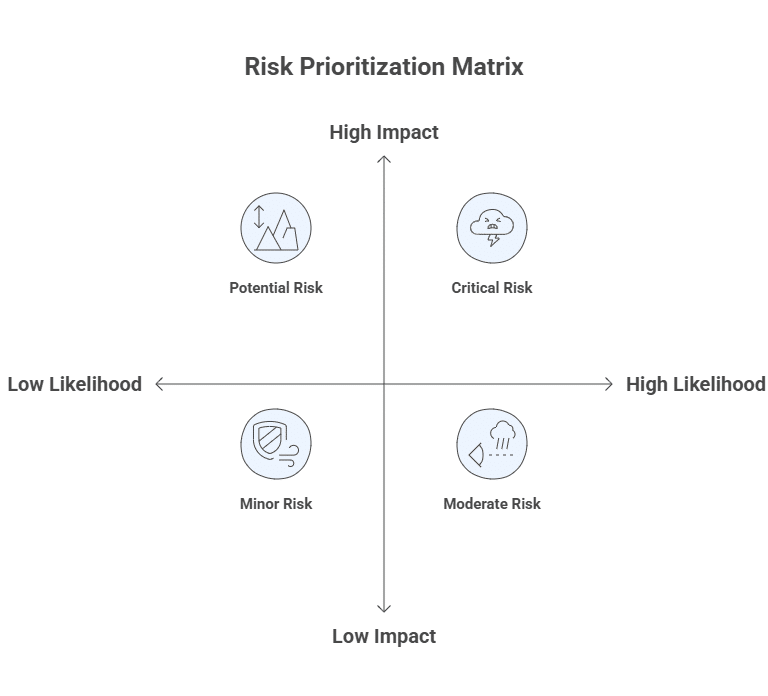
Risk Audit vs Risk Review
When doing a risk audit vs risk review comparison, note that they have similarities and differences.
How they are similar
Both are project management tools used to ensure an appropriate risk management plan and processes for the project’s life cycle. The project manager leads both, should include project team input, and result in information stored with project documentation.
How they are different
The size of the project will determine the frequency and quantity of risk audits; large and complex projects require more risk audits. In contrast, the risk review can be embedded in recurring, standing project status meetings for any size project. At the most basic level, the audit looks back to see if actions taken had a positive outcome on the risk and project, where the review is looking forward to adjusting risk plans to reflect project shifts.
Studying for the PMP Exam?
Risk Audit and Risk Review for PMP Certification Exam
The PMP exam may contain questions to determine to understand the tools’ purpose and when to use the tools for a provided scenario. It is helpful to know for both Risk Audit and Risk Review:
- Definition
- Purpose
- When to conduct
- What it provides for the project
- How it differs from other risk management tools
Risk audits are an audit technique within the Monitor Risk process. Risk reviews fall under “meetings” techniques within the Monitor Risk process of waterfall project management.
Conclusion
Remember don’t fear a risk audit and risk review. Project managers are always looking back to capture lessons learned and looking forward to preparing for what’s coming. Looking in the past (“what happened?”) and in the future (“what could happen?”) is really what the risk audit and risk review are doing.
Upcoming PMP Certification Training – Live & Online Classes
| Name | Date | Place |


 Influencing Without Authority
 (877) 637-0450
 contact@projectmanagementacademy.net
 Mon - Fri | 8:00 AM - 6:00 PM EST


 New Horizons
 Project Management Academy
 Velopi
 Six Sigma Online
 TCM Security
 TRACOM
 Watermark Learning