
 New Horizons
 Project Management Academy
 Six Sigma Online
 TCM Security
 TRACOM
 Velopi
 Watermark Learning
 Login
Login



Key Takeaways
- Decisions Over Tasks: Projects succeed when decision moments are planned, not just deliverables.
- Clarity Prevents Drift: Well-designed checkpoints create intentional moments for judgment and adaptation.
- Ownership Drives Outcomes: Decision quality improves when authority, inputs, and options are explicit.
- Control Through Flexibility: Checkpoints help teams adapt without losing direction or momentum.
- Scaling Without Complexity: Decision frameworks work across simple projects and complex programs.
Projects move faster when teams plan decisions, not just deliverables. Many organizations have capable leaders and modern tools, but lack formal decision frameworks because decision-making is rarely treated as a deliberate discipline. When choices are delayed, teams lose options, alignment erodes, and execution slows.
Project plans can’t eliminate uncertainty. They can create space to make better decisions as work unfolds. It’s crucial to build deliberate decision points directly into project plans so teams can adapt with clarity rather than drift into crisis.
At XentinelWave, project teams recognized this pattern early. Decisions were often made too late, after options had narrowed and costs had risen. The issue wasn’t execution capability or planning discipline; it was decision timing and ownership.
The fix is straightforward: embed design decision moments into plans rather than reacting when problems surface. When teams clarify decision points and ownership, projects stay on track. Projects rarely fail because teams cannot execute. They fail because decisions arrive too late to matter.
What Happens When You Plan the Decision, Not Just the Work
Teams often rely on status meetings because their project frameworks do not clearly define when decisions must occur. Without structured decision points, even experienced leaders default to progress reporting rather than directional choices.
A decision checkpoint is different. It’s a planned moment to choose direction. Teams pause to decide whether to proceed, adjust, pause, or stop, and which option best fits current conditions.
Decision checkpoints aren’t:
- Status meetings: Reporting progress only, without making choices.
- Phase gates: Functioning as approval layers rather than decision moments.
- Executive updates: Informing leadership without requiring their input.
- Review sessions: Critiquing work already completed instead of shaping future direction.
These meetings serve important purposes, but they are not designed to force timely choices. Decision checkpoints exist specifically to make decisions explicit and deliberate.
Milestones track completion, while decision checkpoints guide direction. Yet most project plans emphasize milestones and execution detail, leaving decision moments implicit. That gap explains why well-executed projects still struggle when decisions arrive too late and why planning the work alone is not enough.
Why Traditional Project Plans Miss Decisions
Traditional project plans excel at execution. They specify tasks, tools, and roles in detail. What they often lack is a formal decision-making mechanism. As a result, critical choices remain unplanned rather than engineered into the process. Most teams are prepared to follow plans, not to design and practice structured decisions within them.
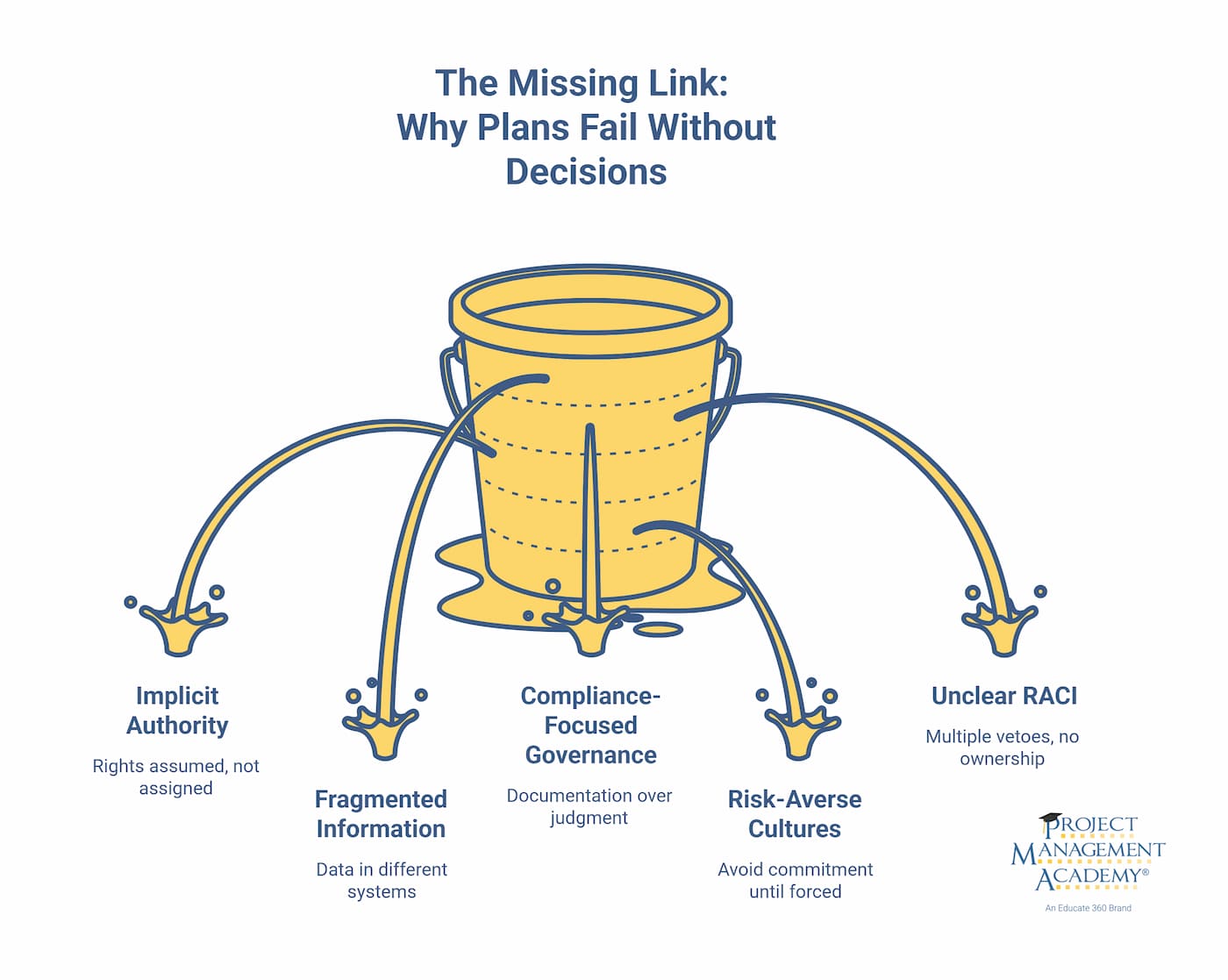
That gap causes problems. Authority only becomes clear under tension, information arrives too late to shape choices, and governance emphasizes compliance over judgment.
Several common patterns obscure decision moments, including:
- Implicit authority: Decision rights are assumed rather than assigned, creating confusion when choices must be made.
- Fragmented information: Data sits in different systems or teams, arriving too late to inform timely choices.
- Compliance-focused governance: Approval structures emphasize documentation over judgment.
- Risk-averse cultures: Teams avoid commitment until forced, narrowing options over time.
- Unclear RACI structures: Multiple people can veto, but no one clearly owns the decision.
These organizational patterns delay commitment and obscure accountability, creating decision latency that rarely appears on project dashboards.
Designing checkpoints directly into the plan closes this gap. It moves decisions from reactive events to planned activities with clear ownership and prepared inputs.
At XentinelWave, recognizing this pattern helps project teams understand why even well-resourced initiatives stall. Teams already have the capability. Adding planned decision moments enables it fully. The next question becomes where these decision moments naturally fit.
The Five Moments When Decisions Matter Most
Decision checkpoints work best when direction matters more than execution. While every project is different, specific patterns show up consistently, and recognizing these natural decision points is straightforward.
The work begins when teams try to design them into project frameworks. Without formal process guidance, teams recognize decisions only after options narrow.
Common decision moments include:
- Scope confirmation: Validating that requirements still reflect business needs.
- Design or approach selection: Choosing between technical or process alternatives.
- Vendor or tool choices: Committing to platforms or partners that shape future work.
- Trade-offs between time, cost, and quality: Deciding what the project can afford.
- Go/no-go points for subsequent phases: Confirming readiness before significant investments.
Timing also matters. Early checkpoints focus on direction-setting and assumption validation. Midpoint checkpoints handle course correction and risk response. Late-stage checkpoints address readiness, acceptance, and transition decisions.
A helpful rule applies across projects: if a decision would be painful to reverse, it deserves a checkpoint. Recognizing these moments is only the first step.
Turning those moments into clear, outcome-driven decisions requires intentional checkpoint design.
Five Elements That Turn Vague Meetings into Real Decisions
Decision checkpoints work when they are designed as formal process elements, not informal meetings. Clarity comes from structure, defined roles, and repeatable decision criteria. Applying these elements consistently requires shared capability, not individual intuition.
The difference between effective checkpoints and unproductive meetings comes down to structure.
Each checkpoint should clearly define:
- The decision to be made: What choice must the team resolve?
- Who owns the decision: Which role has the authority to choose?
- What inputs are required: What data, analysis, or stakeholder input informs the choice?
- What options are on the table: What alternatives are being considered?
- What happens after the decision: How does the choice cascade to related work?
Consider a midpoint checkpoint during a system upgrade. Early prototypes reveal that a custom integration is more complex than expected. A well-designed checkpoint brings the right decision-makers together to review options and make a decision in one meeting, rather than having them drift for weeks.
The alternative is familiar. A meeting gets scheduled, but no one is clear on what must be decided. Information is incomplete, authority is unclear, and related work continues in conflicting directions. Issues escalate without resolution, and momentum stalls.
Decision checkpoints aren’t extra approval layers or replacements for leadership judgment. They exist to make decisions happen by design. When teams get this right, the impact shows up across every dimension of project performance.
The Real Benefits: Faster Decisions, Clearer Direction
The value of decision checkpoints shows up in how projects move. Teams stop reacting to surprises and start steering deliberately. With prepared options in hand, decisions happen at the right time, reducing decision latency and project risk.
These gains are most consistent when teams deliberately apply decision frameworks rather than relying solely on experience.
Specific improvements include:
- Reduced last-minute escalation: Issues surface with time to prepare alternatives.
- Improved stakeholder confidence: Leaders see decisions happening when they’re needed.
- Earlier risk visibility: Problems are identified before options narrow.
- Preventing silent misalignment: Teams confirm their shared understanding before proceeding.
- Momentum through clarity: Decisions unblock work rather than create bottlenecks.
Before decision checkpoints, issues surface without clear ownership or prepared options, causing reactive delays. After checkpoints, teams resolve problems in one session with the data ready. At XentinelWave, this shift changes how teams steer work forward, butonly holds when decisions are clearly communicated.
How Clear Communication Keeps Good Decisions Alive
Making a decision isn’t the same as making it last. Without clear documentation and consistent communication, decisions fade, and teams revisit choices they thought were settled. Brief, structured documentation prevents that drift and keeps everyone aligned.
Effective documentation captures:
- The decision and rationale: What was decided and why it made sense.
- Options considered: Alternatives evaluated and why they were rejected.
- Decision authority: Who made the decision and who was consulted.
- Conditions and assumptions: Factors that might change the decision later.
Cascading decisions to the team requires equal care. Brief team members on outcomes, clarify how the decision affects their work, update relevant project documentation, and confirm understanding before proceeding.
This isn’t bureaucracy. It’s operational discipline. When teams skip this step, decisions fade, and work continues in misaligned directions.
The Principle Scales, The Formality Doesn’t
Decision checkpoints aren’t one-size-fits-all. The principle scales, not the level of formality. Process discipline remains essential, while checkpoint rigor adjusts based on project size and risk, ranging from lighter checkpoints for smaller efforts to more structured escalation for larger initiatives.
The key is to match the approach to the project’s content.
Practical adjustments by project type:
- Small and low-risk projects: Fewer checkpoints, lightweight documentation, faster decision cycles.
- Large or complex projects: More formal checkpoints, cross-functional input, and clear escalation paths.
- Agile and hybrid environments: Checkpoints embedded in planning and review events, decisions focus on direction, not micro-control.
- Integration with existing frameworks: Align checkpoints with current phases, reviews, or iterations without replacing established practices.
What matters isn’t uniformity. It’s intentionality. Every project can benefit from explicit decision moments, even if the mechanics differ. Understanding how to apply checkpoints effectively means also knowing what can go wrong.
Common Decision Checkpoint Pitfalls to Avoid
Well-designed checkpoints deliver results when applied with discipline. Without that discipline, even good intentions can turn decision moments into the exact problems they’re meant to solve.
When teams add too many checkpoints, work slows to a crawl. Others schedule checkpoints but arrive unprepared, turning structured decisions into vague discussions. Still others defer choices indefinitely, using the checkpoint as an excuse to delay rather than decide.
Understanding these patterns helps teams recognize when checkpoints are working and when they’re becoming obstacles.
Patterns that undermine decision checkpoints:
- Treating checkpoints as approval gates: Checkpoints exist to choose direction, not add bureaucratic layers.
- Adding too many decision points: Excessive checkpoints slow work without improving judgment.
- Unclear decision authority: When ownership is ambiguous, decisions stall or escalate unnecessarily.
- Using incomplete or outdated data: Decisions made without current information are often wrong.
- Avoiding decisions under the guise of needing more analysis: Endless study delays choice without reducing uncertainty.
The solution is simple: define what must be decided, who decides, and what information is sufficient, then act. At XentinelWave, this clarity prevents decision checkpoints from becoming the delays they’re meant to avoid. The good news is that teams don’t need perfection to start.
A Simple Way to Start Using Decision Checkpoints
Teams don’t need a new methodology to start experimenting with decision checkpoints. However, sustained results depend on the ability to design and apply them consistently across projects as a shared team capability, rather than as an individual preference. The barrier to action is lower than most assume.
A simple starting process:
- Identify one upcoming decision that matters: Focus on a choice that shapes direction or carries real risk.
- Add a checkpoint to the plan: Schedule the decision moment and name it explicitly.
- Clarify ownership and required inputs: Be specific about who decides and what information they need.
- Test and refine for future checkpoints: Adjust based on what made the decision easier or harder.
The goal isn’t perfection. It’s a better intent. Teams that embed decision-making into their plans make smarter progress than teams that hope decisions will happen on their own.
Better Decisions Make Better Projects
Projects succeed when teams can execute and when decisions happen at the right time. Designing decision checkpoints helps teams adapt without losing control. When decision moments are explicit and ownership is clear, teams move faster with less rework and fewer late escalations.
Strong project management treats decisions as planned events, not surprises. Teams shift from reacting to deliberately steering, using judgment rather than escalation to keep work moving.
Decision-ready leaders don’t wait for clarity; they create it through timely, deliberate choice.
Next Steps: Building Your Foundation
If you’re tired of constantly putting out fires and want to actually lead your projects with confidence, you need more than just a good plan or the latest tool. You need a proven methodology and the judgment to know when to apply it.
That’s what separates good project managers from great ones… not more templates, but the discipline and decision-making frameworks that help you navigate real-world situations no template can solve.
PMA’s PMP Certification Training gives you that structured foundation. Worth checking out if you’re serious about building that capability.


 Influencing Without Authority
 (877) 637-0450
 contact@projectmanagementacademy.net
 Mon - Fri | 8:00 AM - 6:00 PM EST


 New Horizons
 Project Management Academy
 Velopi
 Six Sigma Online
 TCM Security
 TRACOM
 Watermark Learning