

 New Horizons
 Project Management Academy
 Six Sigma Online
 TCM Security
 TRACOM
 Velopi
 Watermark Learning
 Login
Login



PMI just released the PMBOK® Guide Eighth Edition, and with it comes the most significant update to the PMP® exam in years. Beginning July 9th, 2026, the exam will shift to a new standard that includes reweighted domains, expanded content areas, updated terminology, and a more interactive testing experience.
For candidates already working toward their PMP certification, this creates an important decision point. The current exam remains available through July 8th, 2026, after which only the updated version will be offered. Both paths lead to the same credentials, but the study approach, materials, and preparation timeline differ.
Neither option is inherently better. The right choice depends on where you are in your preparation and how you prefer to learn. In this guide, we’ll break down what’s changing in the PMBOK® Guide Eighth Edition, how those updates shape the 2026 PMP exam, and the factors to consider when choosing your certification timeline.
Key PMP Exam Updates for 2026
The PMP exam will incorporate the revised domain weightings, refreshed terminology, and expanded knowledge areas outlined in the new Examination Content Outline. These updates align the test more closely with how project managers work today and ensure that the exam reflects the practices, technologies, and expectations shaping the profession.
Timeline for the 2026 PMP Exam Update
PMI is releasing new materials and exam updates on a defined schedule. Here’s what students need to know:
| Milestone | Date |
| Updated PMP Learning Materials Released | April–May 2026 |
| New PMP Exam Launches | July 9, 2026 |
| Current Exam Retires | July 8, 2026 |
Premier ATPs like Project Management Academy receive new PMI-authorized materials before the general market, ensuring students are trained with accurate, fully updated content.
Major Shifts in Exam Content and Domain Weighting
The new Examination Content Outline (ECO) significantly reshapes domain priorities. The most notable change is the substantial increase in the Business Environment domain.
| Domain | Current Weighting (2021 Exam) | New Weighting (2026 Exam) | Shift |
| Business Environment | 8% | 26% | Massive Increase |
| People | 42% | 33% | Decrease |
| Process | 50% | 41% | Decrease |
The exam will focus far more heavily on strategic alignment, governance, value realization, and external influences, reflecting the modern role of project managers as business-driven decision-makers.
New and Expanded Topics for 2026
The updated PMP exam incorporates several emerging trends that were not fully addressed in previous versions.
Key New Emphasis Areas
- Artificial Intelligence (AI): Predictive insights, resource optimization, schedule analysis
- Sustainability: Environmental, social, and economic considerations in project decisions
- Deeper Stakeholder Engagement: Continuous, value-focused alignment
- Outcome & Value Delivery: Success defined by value, not deliverables alone
- Organizational Strategy: Stronger connection between projects and enterprise priorities
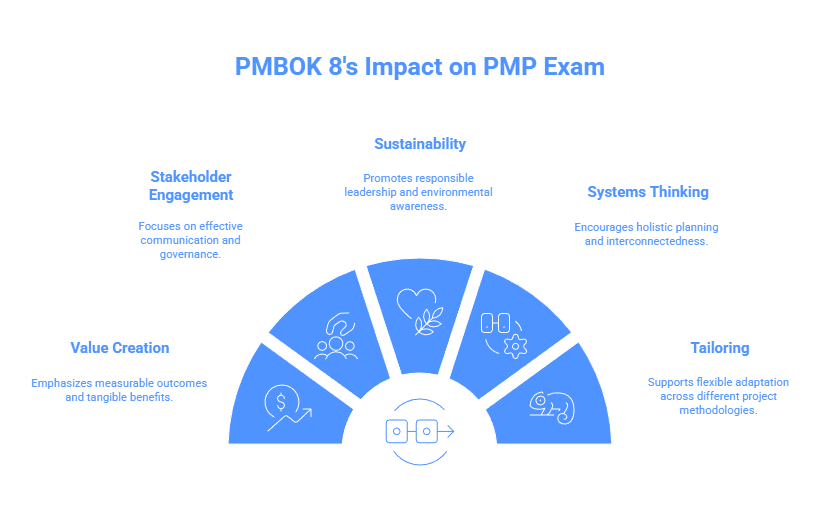
These topics mirror updates in PMBOK 8 and global market expectations for modern PMs.
Exam Format & Question Types
The 2026 exam introduces a more interactive, scenario-driven experience.
Exam Format Comparison
| Feature | Current Exam (2021–2026) | New Exam (2026) |
| Total Questions | 180 | 180 |
| Scored Questions | 175 | 175 |
| Time Allowed | 230 minutes | 240 minutes |
| Breaks | One 10-minute break | Two 10-minute breaks |
| Domains | People, Process, Business Environment | Same, but reweighted |
New Question Types
- Multi-question case studies
- Graphic-based interpretation questions
- Enhanced drag-and-drop interactions
- Complex scenario chains
- Traditional multiple-choice & multiple-select
These changes are intended to assess how candidates think, analyze, and apply information.
Project Management Approaches: Predictive, Agile, Hybrid
The exam remains balanced across delivery methods:
| Approach Type | Estimated 2026 Coverage |
| Predictive | ~40% |
| Adaptive/Agile | ~60% (combined with hybrid) |
| Hybrid | Embedded across all domains |
Candidates must understand how to choose the right development approach, based on context, complexity, and organizational environment.
Updated Eligibility Requirements for the 2026 PMP Exam
PMI has also updated several aspects of the PMP eligibility framework to support a more consistent, globally aligned certification process. These updates apply beginning in 2026.
Extended Eligibility Period
Candidates now have a full 10 years to complete their PMP certification cycle once they enter the eligibility window. This change gives applicants significantly more time to plan their exam, complete their study schedule, and maintain certification status after passing.
Aligned Global Experience Requirements
PMI has standardized the required project management experience across degrees, apprenticeships, and recognized training programs. The updated guidelines state that candidates must demonstrate 3 to 5 years of project management experience, depending on their educational background. This change removes regional variation and makes eligibility more consistent worldwide.
Education and Contact Hours
The existing requirements for education and contact hours remain the same. Candidates still need 35 contact hours of project management education or approved training.
These updates ensure a more flexible and consistent certification pathway while maintaining the rigor of the PMP credential.
What’s Not Changing in the 2026 PMP Exam
While the PMP exam is receiving major updates in 2026, several important elements remain the same. These consistency points help candidates avoid confusion and ensure that preparation stays focused on what truly matters.
The PMP Exam Domains Are Still People, Process, and Business Environment
The domain weighting is changing, but the three-domain structure itself stays the same. Candidates will still be tested on interpersonal skills, project processes, and the project’s broader environment.
Predictive, Agile, and Hybrid Approaches All Remain
The updated exam continues to cover the full range of delivery methods. Predictive, agile, and hybrid scenarios remain central to exam questions, and candidates must still understand how to apply the right approach in different situations.
The Application and Audit Process Are Not Changing
PMI has not announced any changes to the application, approval, documentation, or audit process. Candidates can expect the same steps and requirements they are familiar with today.
The PMP Credential Itself Remains the Same
Whether you earn the credential before or after July 9, 2026, it is the same globally recognized PMP certification. There are no separate versions, and there is no “old” or “new” PMP designation.
The Exam Structure Still Uses Situational and Scenario-Based Questions
Even with new interactive features, the exam continues to emphasize practical, real-world project management judgment. The shift enhances the format but does not replace the test’s scenario-driven nature.
Why This Update Matters, and How PMBOK 8 Aligns
The 2026 PMP exam reflects PMI’s shift toward the skills project managers need today. Instead of testing memorized processes, the new exam focuses more on how you think, how you make decisions, and how you guide a project to deliver real value. This includes working with stakeholders more effectively, adjusting your approach based on context, and using data, including AI tools, to support project decisions. It also places greater emphasis on aligning projects with business strategy, rather than just completing tasks.
These priorities align with the updates in the PMBOK® Guide: Eighth Edition. PMBOK 8 introduces clearer principles, a more organized structure, and practical processes that help project managers apply the guidance in real-world situations. Together, the updated PMBOK and the new PMP exam offer a more modern, realistic view of what successful project management looks like today.
Should You Take the Exam Before or After July 9?
Now that the timelines and changes are clear, the next step is choosing which exam version fits your situation. Most candidates fall into one of two practical paths, depending on how close they are to testing and how they prefer to learn.
Option 1: If You’re Already Preparing and Close to Ready
Some candidates have been studying for a while, are comfortable with the current exam format, and want to finish before the transition. For them, the current exam represents stability: widely available resources, established question patterns, and a clear target.
This approach works best for learners who:
- Can complete their prep and test by July 8th, 2026
- Prefer staying with the study materials they already know
- Want to avoid shifting to new terminology and updated frameworks
- Are confident they can maintain momentum over the next few months
Project Management Academy supports this group with:
- Instructor-led PMP Certification Training offered through July 8th
- Structured study plans designed to fit the remaining timeline
- A refresher option for past PMA students returning to finish before the cutoff
- A fast-paced but guided approach to ensure exam readiness before the switch
Option 2: If You’re Starting Now or Prefer Updated Content
Other candidates are just beginning their journey or want to learn the most current version of the PMP exam. For these learners, it makes more sense to use the updated PMI-authorized materials, align with the new ECO, and prepare using the concepts reflected in PMBOK® Guide 8th Edition.
This option fits learners who:
- Are not yet deep into exam prep
- Prefer modernized, principle-driven exam content
- Want to study with materials specifically created for the updated exam
- Don’t want to rush to meet the July testing deadline
Project Management Academy supports this path with:
- The new PMI-authorized PMP course, launching May/June 2026
- A one-day Bridge Class for past students transitioning to the new blueprint
- Updated curriculum aligned to the revised domains, competencies, and terminology
- Guided preparation for the exam version that will remain in place long-term
The Key: Don’t Wait Without a Plan
The exam isn’t necessarily getting harder; it’s simply changing. The real risk isn’t choosing the wrong version but postponing your preparation without considering how timing affects your success. Project Management Academy helps you determine whether you’re positioned to complete the current exam, whether it makes more sense to prepare for the updated version, and how each path aligns with your schedule and learning style.
Suppose you’ve already taken a class based on the current exam. In that case, PMA also offers a Bridge Class to help you transition smoothly to the new content without having to start over. With clear guidance and the right support, you can move forward confidently, no matter which exam version you choose.
What’s Actually Different? PMBOK 7 → PMBOK 8 Expected Shifts
PMBOK® Guide Seventh Edition marked a significant shift toward principles, performance domains, and value delivery—away from prescriptive processes toward a more flexible, context-driven model. The Eighth Edition builds on that direction but responds directly to practitioner feedback: many professionals wanted clearer guidance, more structure, and a stronger bridge between high-level principles and day-to-day project execution.
While PMBOK 8 is not a return to the highly prescriptive style of earlier editions, it does restore some of the practical clarity missing from the Seventh Edition. It blends the strengths of both approaches: the adaptability of modern project work with a more grounded technical foundation.
Key Differences at a Glance
| Area | PMBOK 7th Edition | PMBOK 8th Edition |
| Principles | 12 broad principles with some overlap | Smaller, more focused set, including sustainability and an empowered culture |
| Structure | Principles and 8 performance domains | 7 performance domains aligned to daily PM responsibilities |
| Process Guidance | Minimal process direction | About 40 nonprescriptive processes integrated into each domain |
| Delivery Approach | Strong emphasis on value and outcomes | Blends value focus with clearer technical guidance for real-world execution |
| Tailoring | Recommended across projects | Built in as a default expectation within domains and processes |
| Modern Topics | High-level coverage | Deeper integration of AI, uncertainty management, hybrid delivery, and complex stakeholders |
For a full breakdown of the principles, domains, and process changes, read our detailed guide on the PMBOK 7 to PMBOK 8 transition:
Full PMBOK 7 vs PMBOK 8 Comparison Blog
Choosing the Right PMP® Exam Version for 2026
With the 2026 PMP® exam update approaching, your key decision is whether to complete the current exam or prepare for the updated version launching July 9, 2026. Both lead to the same credential, but the study experience and question styles differ, and the right choice depends on your readiness, timeline, and preferred learning style.
Project Management Academy supports both paths. As a Premier ATP with early access to PMI-authorized materials, we offer instructor-led courses for the current exam, updated training aligned to the new blueprint, and a Bridge Class for those who need to transition without starting over. With PMA, you won’t just prepare for the PMP exam, you’ll choose the version that sets you up for success.
Frequently Asked Questions About the 2026 PMP Exam Changes
Is the PMP exam changing in 2026?
Yes. The PMP exam will update on July 9, 2026. This new version aligns with the PMBOK Guide Eighth Edition, including new domain weightings, expanded content areas, updated terminology, and more interactive question types.
Will the new exam be harder?
Not necessarily. The exam is different, rather than harder. The 2026 version focuses more on real-world judgment, scenario analysis, and critical thinking. Many candidates find applied questions easier to understand than memorization-style questions.
What are the most significant differences in the 2026 PMP exam?
The most important updates include a significant increase in the Business Environment domain, new topics such as AI and sustainability, revised terminology aligned with PMBOK 8, and new question types, including case sets, drag-and-drop, and graphic interpretation.
Key changes include:
- The Business Environment domain increases from 8 percent to 26 percent
- Greater emphasis on AI, sustainability, value delivery, and organizational strategy
- New interactive question formats, such as drag and drop, graphics, and case sets
- A revised format with 180 questions and two 10-minute breaks
- Updated terminology aligned to PMBOK Guide Eighth Edition
Should I take the current exam or wait for the new one?
It depends on your timeline.
Take the current exam if you are already preparing and can take the test before July 8th, 2026.
Wait for the updated version if you are currently starting or prefer to learn the newest frameworks and terminology. Both versions lead to the same credential.
How does the PMBOK Guide Eighth Edition affect the PMP exam?
PMBOK 8 introduces refined principles, reorganized domains, reintroduced nonprescriptive processes, and stronger guidance for tailoring and modern delivery environments. These updates influence the exam’s terminology, topics, and question scenarios.


 Influencing Without Authority
 (877) 637-0450
 contact@projectmanagementacademy.net
 Mon - Fri | 8:00 AM - 6:00 PM EST


 New Horizons
 Project Management Academy
 Velopi
 Six Sigma Online
 TCM Security
 TRACOM
 Watermark Learning