
 New Horizons
 Project Management Academy
 Six Sigma Online
 TCM Security
 TRACOM
 Velopi
 Watermark Learning
 Login
Login



Key Takeaways
- Hidden PM work: Employees across departments manage projects without a formal title or mandate
- Process gap: Inconsistent process, not a lack of effort, drives delays and rework
- Skills validated: Business Analysis, the domain most tied to informal work, makes up 27% of the CAPM exam
- Delegation shift: Recognition changes how managers delegate, track, and maintain accountability
- Scale problem: One person’s framework doesn’t fix a department’s shared inconsistency
Picture a handful of department heads sitting down for a post-mortem. The project wrapped weeks late. Vendor delays piled up, scope crept without anyone flagging it, and deadlines slipped one after another until the whole thing fell behind.
As the group compares notes, a pattern emerges. None of their teams ever formally assigned anyone to lead, and none of the people doing the work have had real project management training. The real issue is a structural gap, one of the easiest gaps to close.
This gap shows up in and between departments. Employees gather requirements, coordinate cross-functional stakeholders, and manage scope and timelines every day without a project management title.
When department heads look for training to close that gap, many land on the PMP first, PMI’s flagship certification, then find it requires 36 to 60 months of documented, verified experience leading and directing projects. Scope and authority matter more than title, and someone running smaller projects informally may not yet clear that bar.
PMI built the CAPM for this gap. It has no experience requirement, and its curriculum validates the kind of requirements-gathering and stakeholder work these employees are already doing.
This work deserves a framework that formalizes it, one that gives a team a clear path to putting it to use.
Recognize the Work Already Happening
Recognition starts with naming what employees are doing. Across departments, they coordinate timelines, chase approvals, manage stakeholders, and keep initiatives moving without a formal title or mandate. It carries no project management title, but all of it is project management.
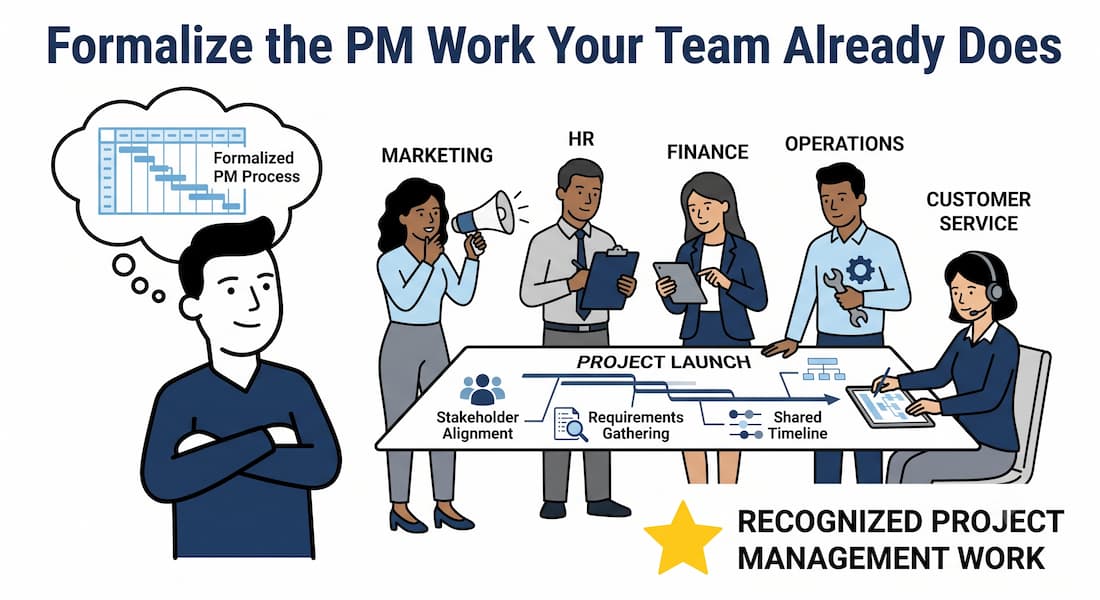
This pattern isn’t confined to one function. Picture a single product launch: marketing coordinates the campaign, HR handles onboarding, finance updates reporting, operations manages the vendor transition, and customer service preps new procedures. One project, five departments, five people running their own version of project management.
Each of these people would tell you they’re not a project manager. All five are doing the work anyway, without a shared method.
Informal project leads succeed early by relying on personal judgment and memory, an approach that holds up for small, contained work but breaks down once a project grows more complex or crosses multiple teams, since each person ends up inventing their own way of planning and tracking progress.
The inconsistency shows up the same way across departments:
- Ad hoc tracking: Status lives in email threads, sticky notes, or someone’s memory instead of a shared system
- Unclear ownership: Multiple people assume someone else is watching a deadline or vendor deliverable
- Reinvented processes: Each project lead builds their own way of scoping and reporting, so nothing transfers between teams
- Silent scope creep: Teams absorb changes informally instead of flagging and evaluating them
📊 The world will need up to 30 million new project professionals by 2035, on top of the nearly 40 million already working today. (PMI, Global Project Management Talent Gap report)
Inconsistent process, not a lack of effort, is what drives up rework and pushes deadlines past their target. CAPM formalizes this work into a shared standard, one built directly around the tasks these teams already handle.
Map Informal Skills to a Framework
CAPM’s four domains mirror how teams deliver projects, and one of them lines up almost exactly with the work these teams are already doing.
Project Management Fundamentals covers the foundational vocabulary and roles. Predictive, Plan-Based Methodologies is one domain, and Agile Frameworks is another, each covering a different delivery approach. Business Analysis, the domain most directly tied to the informal work happening across departments, covers requirements gathering, stakeholder communication, and solution evaluation.
Employees often handle these tasks without realizing they’re part of a formal framework:
- Requirements gathering: Identifying what a project needs to deliver before work begins
- Stakeholder communication: Keeping the right people informed and aligned as a project moves forward
- Solution evaluation: Confirming that the finished work solves the original problem
Skipping any of these has a predictable cost. Unclear requirements appear later as scope creep, since nobody agreed on the target up front. Weak stakeholder communication creates misalignment that shows up once a deliverable misses the mark. CAPM’s Business Analysis domain exists because these failures are common enough to formalize a defense against them.
📊 Business Analysis Frameworks make up 27% of the CAPM exam. (PMI, CAPM Examination Content Outline)
None of this is new territory for someone who has spent years scoping work, managing vendors, and keeping stakeholders aligned without a formal title. Once a domain and a standard back that work, it stops being something a manager takes on faith and becomes something they can plan around.
Change How Work Gets Assigned
Once managers map informal work to the CAPM framework, the next question is what changes day to day. Assignment is one of the clearest places this change appears. Before recognition, a manager hands off a project based on who seems available and hopes it goes well.
Responsibility ends up spread across a few people, and no one is sure who owns what. Recognition changes that. Assignment gets specific, managers set expectations before the work begins, and everyone works from the same playbook.
Recognized, standardized skills give managers something concrete to build on:
- Delegation: A manager can assign scope based on demonstrated capability, not a guess
- Accountability: Clear ownership means a missed deadline points to a decision, not a mystery
- Repeatability: One project’s process can transfer to the next instead of starting from scratch
- Predictable execution: Timelines hold because the approach behind them is consistent
The shift shows up in the language itself. Before standardization, an assignment sounds like, “Can you take this project?” After, it sounds like, “You own stakeholder communications through planning, weekly status reporting, and documenting any approved scope changes.” The second version leaves nothing to interpretation.
A common objection surfaces here. Shouldn’t these employees get more experience first, before adding a certification into the mix? Experience and eligibility are two different requirements, and this assumption conflates them, since PMP requires documented experience leading and directing projects while CAPM requires none.
The gap between the two credentials comes down to two questions: how much experience each one requires, and who each one fits.
| CAPM | PMP | |
|---|---|---|
| Experience required | None | 36 to 60 months leading and directing projects |
| Who it fits | Employees building toward formal recognition | Professionals with documented leadership history |
The comparison makes the CAPM decision straightforward for anyone still weighing whether it applies to a given employee.
One manager delegating with confidence solves a single team’s problem. The next step is recognizing that the same inconsistency, repeated across every department, is what turns individual gaps into a cross-team breakdown.
Make the Case Team-Wide
This cross-team breakdown is exactly what those department heads walked into during their post-mortem. Every manager at the table had a version of the same story: a project that slipped because no one had the standard or the authority to catch it early. What looked like one failed rollout was the same gap showing up in five different places at once.
One person gaining a shared framework doesn’t fix a department where five people are each inventing their own process. The inconsistency between them is what causes handoffs and cross-team dependencies to break down. Closing the gap has to happen across the team, not within one role.
A few signs point to a team that’s ready for this kind of investment:
- Recurring handoff friction: The same kind of miscommunication shows up on every project, regardless of who’s leading it
- No shared vocabulary: Team members describe the same task differently depending on who’s talking
- Inconsistent status reporting: Some project leads track progress closely, others barely check in
- Repeated scope surprises: Changes keep showing up late instead of teams flagging them early
A department head doesn’t need a formal audit to spot this. It shows up in status meetings where every project lead reports differently, or in a post-mortem where the same root cause resurfaces under a different name each time.
Left alone, these signs don’t stay contained to one team. When every department reports differently, executives lose the ability to compare project health across the organization. The same inconsistency slows cross-functional work, since no one can predict how another team’s process runs.
New hires pay a cost too, learning a different set of expectations with every project they join. This ramp-up cost compounds every time the team turns over, since there’s no standard playbook to hand a new hire on day one.
Training a team on CAPM’s framework gives every project lead the same starting point. Reporting looks the same regardless of who’s running the project, managers make assignment decisions the same way across the department, and the next post-mortem is far more likely to be a short one.
Turn Individual Instinct Into a Shared Standard
Recognizing informal project work matters beyond fairness. It’s how a department stops depending on guesswork and starts running on a shared standard, one that scales from a single project lead to an entire team.
Once managers recognize this work, everything downstream changes. Every assignment has an owner, every missed deadline has an explanation, and a department stops depending on five different people inventing five different processes. The same standard that helps one project lead is what keeps the next cross-team rollout on track from the start.
Project Management Academy partners with organizations to bring that standard to their teams. Its instructor-led CAPM training helps department heads turn informal project work into a credentialed, repeatable practice across every team that needs it.
The credential matters because of what it prevents. Trained teams walk into their next post-mortem with a shared standard behind every decision, not five different explanations for the same breakdown.
Which of your teams is still running on instinct instead of a shared standard?
Explore Project Management Academy’s CAPM training and give your teams the shared standard their project work already deserves.


 Influencing Without Authority
 (877) 637-0450
 contact@projectmanagementacademy.net
 Mon - Fri | 8:00 AM - 6:00 PM EST


 New Horizons
 Project Management Academy
 Velopi
 Six Sigma Online
 TCM Security
 TRACOM
 Watermark Learning