
 New Horizons
 Project Management Academy
 Six Sigma Online
 TCM Security
 TRACOM
 Velopi
 Watermark Learning
 Login
Login


Key Takeaways
- Intake as Diagnosis: Intake is where PMs determine whether the information they’ve been given is sound
- Strategic Fit First: The two most important intake questions focus on strategic fit, not scope, budget, or timeline
- Read the Constraints: Timelines and budgets at intake are often opening positions, not fixed facts
- Know the Full Landscape: Intake is where PMs identify who else should be involved before the project moves forward
- AI as Pressure-Tester: Prompted correctly, AI interrogates a brief and uncovers gaps the intake process may miss
A physician doesn’t treat based on what the patient says is wrong. They take the chief complaint seriously, then run diagnostics. Most project managers are trained to do the first part. A sponsor walks in with energy and a rough scope, the PM collects the information, and the project enters the queue. The brief enters the queue before anyone asks whether it’s actionable.
Mid-project problems originate at this stage of the process. Unrealistic timelines. Dependencies nobody mapped. Executive escalations that felt like ambushes but were visible from the start, to anyone who looked.
Most of those failures trace back to the intake process. Projects were built on information that was never tested, with assumptions locked in before the first status report was written.
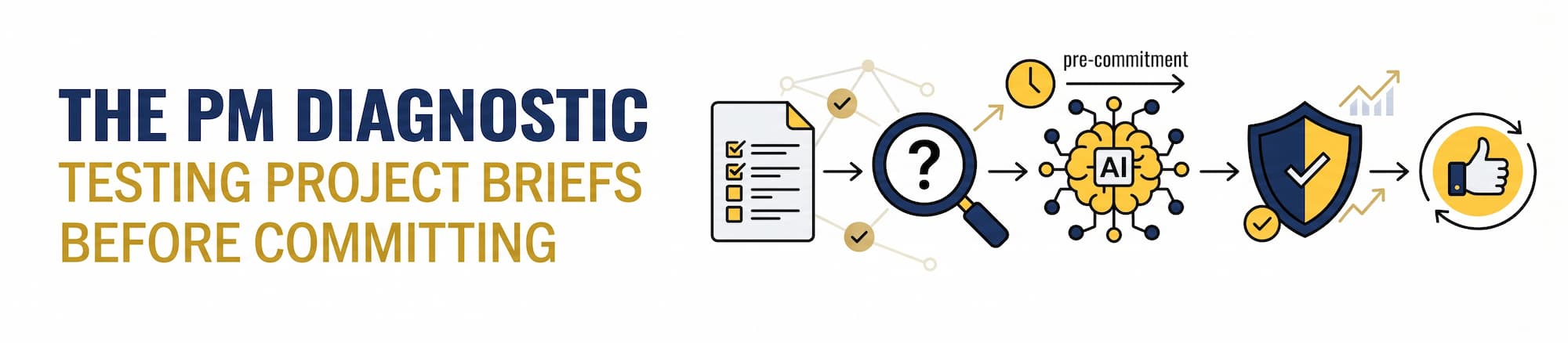
Intake is a diagnostic stage. A PM’s job is to determine whether what they’ve been told can be verified before committing to a delivery path built on it. Asking the right questions is what makes that judgment possible, and AI has become a practical partner in that process.
How Sponsor Bias Frames the Brief
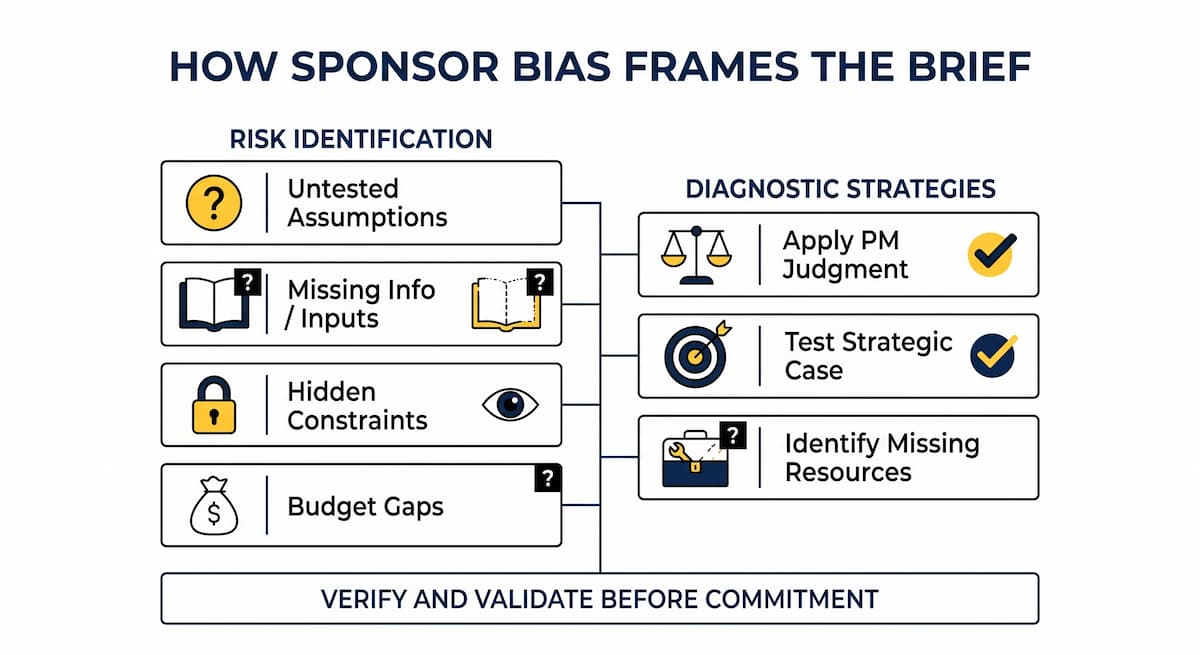
Every project request arrives through someone with a stake in its approval. Sponsors naturally emphasize information that supports the outcome they’re advocating for, which means the brief a PM receives at intake is shaped before the first question gets asked.
Asking hard questions takes confidence. There’s real pressure to accept what’s been offered and move on. PMs who resist it catch problems while there’s still time to address them.
Sponsor bias is invisible to the PM at intake because it shapes what gets shared, often without the sponsor realizing it. Intake is where PMs apply their judgment to determine whether what they’ve been offered is reliable before the organization commits to it. Testing the strategic case is how that work starts.
Test the Strategic Case Before You Touch the Scope
Most intake conversations start with scope, budget, and timeline. Those details matter, but they’re the wrong place to begin. The first two intake questions go deeper, establishing whether the project should exist in its current form before any of those details get locked in.
Question One
What problem does this project solve, and is it the right problem? Requests often come with a predetermined solution. It’s the PM’s job to assess whether it fits.
Question Two
Why does this need to happen now? Project requests often come with implied urgency but lack a rationale. Understanding the urgency tells the PM whether it’s a real constraint or a negotiating stance.
Both questions open three lines of questioning worth pursuing before the project moves forward:
- Problem validity: Does the solution map to the stated problem, or is it only addressing a symptom?
- Alternative analysis: Were other approaches considered, or did this solution arrive without any comparison?
- Cost of inaction: What happens if this project doesn’t move forward, and is the answer clearly defined?
Together, they give the PM a clear read on whether the project’s strategic foundation holds before scope, budget, or timeline enter the conversation.
A strategic case the PM can’t verify tells them the project isn’t ready to move forward. Whether the strategic case holds or doesn’t, the PM has an answer before the project enters the queue. Once they confirm the strategic foundation, the next test is whether the constraints the project is built on are real.
How to Interpret the Constraints
Constraints are where sponsor optimism is most likely to show up as fact. Timelines and budgets at intake often reflect what the sponsor wants to be true, and understanding where they came from is what tells the PM whether they’re valid or negotiable.
Question Three
How was the timeline determined, and who owns it? A timeline pulled from a planning meeting without supporting data may have no relationship to what the work requires. A timeline derived from the work itself gives the PM something to plan against.
Question Four
Where did the budget number come from? Budgets at intake can be modeled against a scope estimate or reverse-engineered from a number someone already decided on. The difference tells the PM how much the number can move.
A few follow-up questions help the PM determine how much flexibility the constraints carry:
- Flexibility range: “If scope or complexity turns out to be larger than assumed, is there a process for revisiting either?”
- Prior precedent: “Has the organization done something similar before? What did it cost and take?”
Both questions tell the PM how much room exists to adjust before the project moves forward.
A PM who knows which constraints are fixed and which can move has a planning advantage before the project starts. Verified constraints give the PM a clearer picture of what the project can deliver. A clearer picture is only useful if the right people agree on it before the project launches.
How to Read the Political Landscape Before the Project Launches
Projects don’t fail in a vacuum. The people behind them shape the outcome as much as the plan. Poor stakeholder management derails projects as often as poor planning. Intake is the only point at which PMs have enough distance to read the political landscape before commitments are made.
Question Five
Who owns the outcome, and is that person the same one who owns the budget? Determining this at intake prevents the PM from discovering the misalignment mid-project, when it’s much harder to address.
Question Six
Who has the authority to stop this project, and are they aware it exists? This is the political question PMs often avoid at intake because it seems presumptuous. It’s often the most important one to ask. It also raises a related question: which departments or leaders will be affected but weren’t included during intake?
A complete stakeholder analysis happens after intake. For now, the PM needs enough information to know who should be involved before committing.
Once the PM has examined strategy, constraints, and stakeholder alignment, they have enough context to evaluate what the project is built on. The assumptions underneath the brief are where the remaining risk lives, and this makes AI a practical intake tool.
Use AI to Pressure-Test What You’re Being Told
Most PMs think of AI as a tool for getting work done faster. At intake, it’s most valuable as a thinking partner. When prompted with the right questions, it interrogates the brief and shows gaps that are easy to overlook.
Question Seven
What assumptions is this project built on, and which ones haven’t been tested? Prompting AI to identify what would have to be true for the project to succeed uncovers gaps in the brief that are easy to miss.
Untested assumptions are where early risk lives, making the next question a natural follow-up.
Question Eight
What does a realistic risk picture look like at this stage? AI can build an early risk picture from the brief before the PM locks scope and makes resource commitments, while there’s still room to act on what it finds.
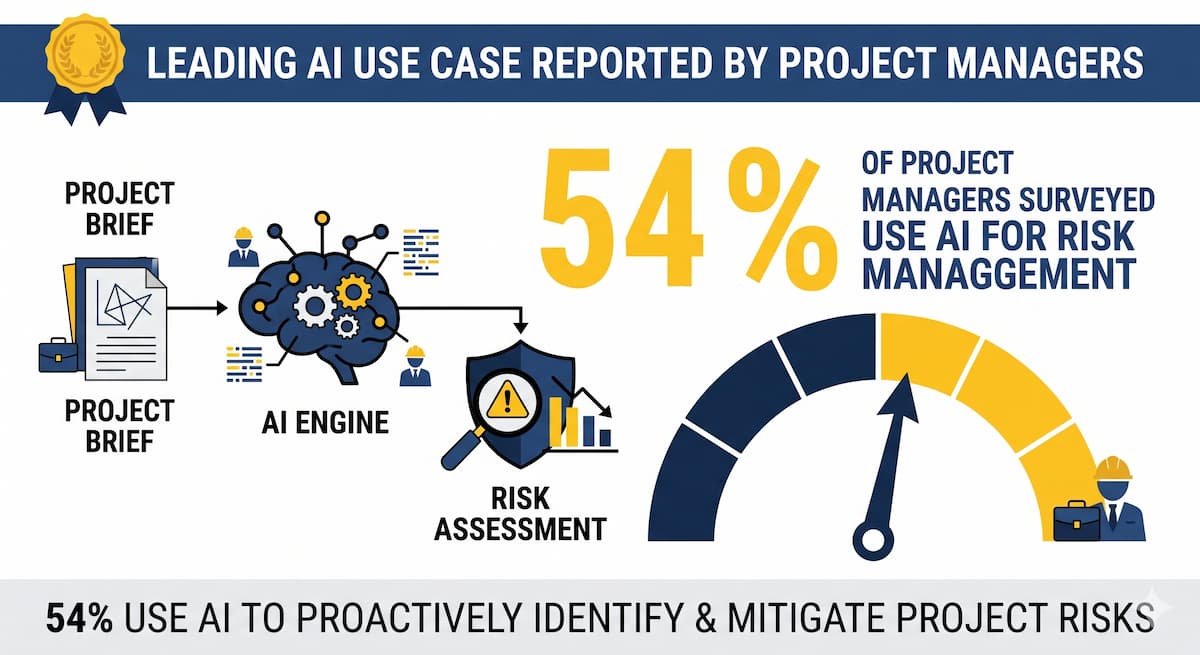
Most PMs apply AI during execution, after they lock the brief and make commitments. Shifting the habit to intake is where it does its best work. AI can interrogate a brief, but it can’t read a room. The nuance a PM picks up from a conversation, including hesitation, office politics, and unstated priorities, is what gives AI output the context it needs to drive well-informed decisions.
Strategy, constraints, stakeholders, and early risk give the PM most of the information they need to decide. The final two questions complete the picture.
The Final Call Before You Commit
Every question in this framework has been building toward one moment: the decision to move forward or not. Readiness is the final test before commitment. The earlier questions establish what the project is meant to accomplish. The last two determine whether the organization is ready to do it.
Question Nine
What has to be true for this project to succeed, and how many of those things are already true? Naming the conditions for success and counting how many are in place tells the PM whether the project is ready to move forward. It also identifies which conditions depend on things outside the PM’s control, and that’s where planning needs to start.
Question Ten
What is the cost of proceeding if any of those conditions turn out to be false? Collecting information without testing it leaves the project exposed from day one. Knowing the cost of proceeding on false assumptions is what gives the PM the ability to make an informed recommendation before commitments are locked in.
The intake framework isn’t a checklist. It’s a discipline that changes what a PM can see before the project starts. PMs who apply it consistently catch problems earlier, make stronger decisions, and build credibility through projects that deliver what they promised. It’s built question by question, project by project, until better intake becomes the standard rather than the exception.
The Discipline That Changes What Projects Deliver
Treating each project request as a hypothesis worth testing before committing to it is what separates reactive PMs from deliberate ones. Projects built on verified information deliver more reliably because the problems that derail them get caught before commitments are locked in.
AI expands what PMs can test during intake. Those who use it as a diagnostic partner at this stage can pressure-test a brief faster than any manual process allows. The PMs getting the most value from AI apply it early enough to shape decisions before commitments are made.
Intake discipline compounds. Each project builds on the last, sharpening the judgment and instincts that separate good PMs from great ones. Over time, the habit of testing before committing earns PMs the kind of trust that leads to bigger projects and broader mandates. That’s the competitive advantage stronger intake builds.
Project Management Academy partners with organizations to develop project managers who ask better questions, make better calls, and deliver better outcomes.
Is your team ready to treat intake as a diagnostic process?
Explore PMA’s courses and certifications and build the judgment and process discipline that stronger intake requires.


 Influencing Without Authority
 (877) 637-0450
 contact@projectmanagementacademy.net
 Mon - Fri | 8:00 AM - 6:00 PM EST


 New Horizons
 Project Management Academy
 Velopi
 Six Sigma Online
 TCM Security
 TRACOM
 Watermark Learning