
 New Horizons
 Project Management Academy
 Six Sigma Online
 TCM Security
 TRACOM
 Velopi
 Watermark Learning
 Login
Login



Key Takeaways
- Consistency Gap: Process inconsistency across departments is a structural problem, not a people problem
- Hidden Costs: Nobody notices the cost of inconsistent project habits until work starts falling through the cracks
- Shared Foundation: Most people don’t need PMP certification; they need a shared understanding of how projects work
Someone new to managing projects joins a cross-departmental initiative and almost immediately notices something off. One team tracks progress through weekly email chains. Another holds daily standups that nobody outside the department attends.
A third considers a project complete the moment the deliverable is finished, with no formal close-out, no handoff documentation, and no confirmation that the receiving team has what it needs to move forward. Nobody is doing anything wrong. They’re each doing what they’ve always done.
Then something slips. A deliverable lands late because two teams had different assumptions about who owned the final review. Emails fly. A manager gets looped in. The launch date moves. They watch the chaos unfold and think: why isn’t there one shared approach everyone follows?
That question is the right one. It points to one of the most common, least-named problems in project work. When everyone defaults to habits from a previous job, school, or trial and error, no one is managing projects badly. They’re just managing them the only way they know how.
The Work Isn’t Breaking Down. The Handoffs Are.
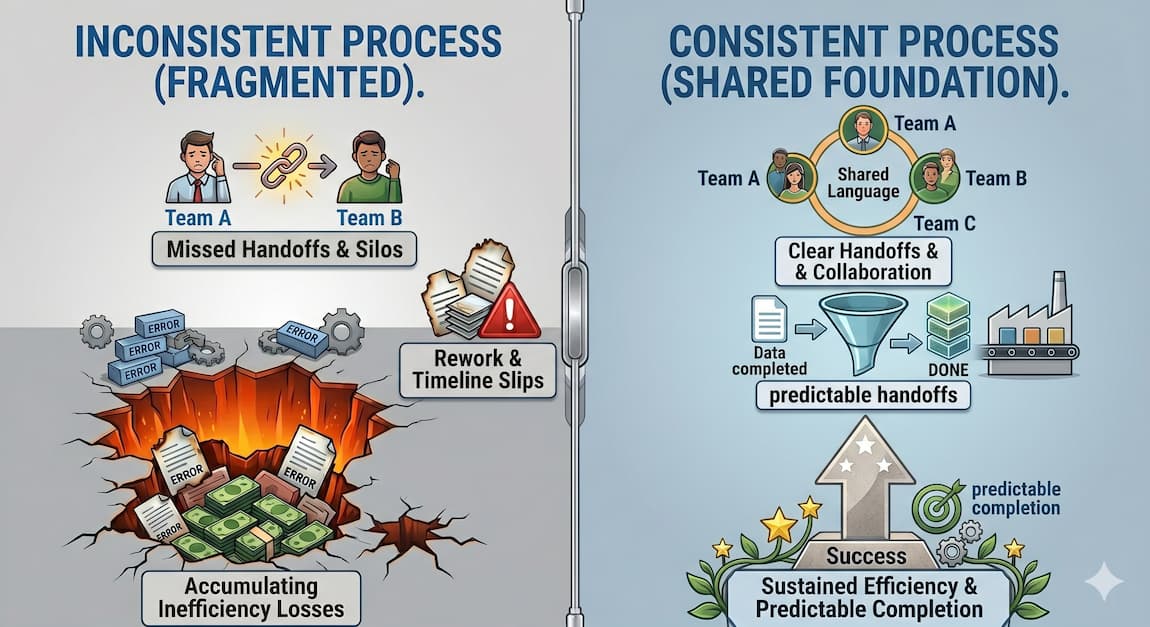
The trouble with inconsistent project practices is that nobody notices until something breaks. By then, the damage has already piled up. Missed handoffs, ownership gaps, rework from two teams with different ideas about what “ready” meant.
Think about what that looks like in practice. One department closes out a project and moves on. The team that picks it up discovers the documentation is incomplete, the status is unclear, and the contacts who have context have already moved on to something else.
Multiply that across every project, every team, every quarter, and the costs pile up
Teams feel it before they can name it. The steady accumulation of small losses rarely gets traced back to process inconsistency. It gets called “how things are around here.”
Stop Blaming People, Look at the Process
When a handoff breaks down or a timeline slips, the instinct is to look for the person who dropped the ball. That instinct is understandable. It’s also wrong.
Process inconsistency doesn’t develop because teams are careless. People bring the habits they built somewhere else, a previous employer, a certification course, or a self-taught approach that worked on smaller projects. With no standards set, many organizations add people and complexity long before anyone thinks to define how projects should run.
Research shows that 42% of project managers don’t follow a defined project management methodology, and those projects are 15% less likely to meet goals and stay within budget.
Nobody sits down and decides that five departments will run projects five different ways. It happens because processes are assumed rather than defined. This is a process problem wearing a people costume.
Here’s what that looks like in practice across most teams:
- No agreed definition of done: Each team decides for itself what completion looks like, which means handoffs rarely land cleanly.
- Inconsistent status reporting: Some teams send weekly updates. Others go silent until something breaks. Nobody has the full picture.
- Ownership gaps at handoff: Work moves between teams without a clear record of who is responsible for what comes next.
- Ad hoc close-out practices: Projects end without documentation, lessons learned, or confirmation that the next team has what it needs.
None of these is a personality flaw. They’re process gaps that exist because there is no defined standard to work from.
Many teams have never been taught the basics: how to define scope, assign ownership, track progress, and close out cleanly. That’s not a skills gap. It’s a knowledge gap, and it’s fixable.
Process gaps don’t close on their own. They close when teams decide to work from the same foundation.
Three Simple Agreements That Change How Your Team Works Together
The path from process chaos to process consistency doesn’t require an organizational overhaul. It starts with a few deliberate agreements, entry points into a shared way of working that reduce variability and give teams a common language for project work.
Three agreements make an immediate difference:
- Define “done” before the project starts: Agreed completion criteria close the most common handoff gap before it opens.
- Pick one check-in rhythm and hold it: Consistent check-ins build shared muscle memory and keep everyone on the same page.
- Establish one shared reference point: When status, ownership, and next steps live in one place, the question of who owns what no longer arises.
When these agreements are in place, something shifts. Handoffs become predictable. Teams stop losing time as projects move between departments. Standardization doesn’t mean rigidity. It means everyone knows the rules of the game before projects start.
Getting everyone aligned doesn’t require authority. It requires someone willing to name the problem and propose a starting point. The person who introduces a structure isn’t just solving a logistics problem. That’s someone giving their team a common foundation to work from.
You Already Know Something Is Off. Here’s What to Do About It.
Process inconsistency isn’t a people failure. It’s a missing foundation. When everyone works from the same definition of done, the same check-in rhythm, the same place to find project status, the gaps between teams stop being where work disappears.
When the deliverable slips, the emails fly, and the launch date moves, someone always notices. The ones who act on what they see rather than wait for someone else to are the ones who stop managing projects and start leading them.
Partnering with Project Management Academy means you don’t have to figure this out alone. PMA’s instructor-led project fundamentals training gives professionals at every level the structure and hands-on practice to stop improvising and start managing projects the right way.
Is your team ready to stop running projects five different ways and start working from a shared foundation?
Explore Project Management Academy’s project management foundations training and start building the foundation your team has been missing.


 Influencing Without Authority
 (877) 637-0450
 contact@projectmanagementacademy.net
 Mon - Fri | 8:00 AM - 6:00 PM EST


 New Horizons
 Project Management Academy
 Velopi
 Six Sigma Online
 TCM Security
 TRACOM
 Watermark Learning