
 New Horizons
 Project Management Academy
 Six Sigma Online
 TCM Security
 TRACOM
 Velopi
 Watermark Learning
 Login
Login



Key Takeaways
- Experience Is the Foundation: PM experience helps and hurts; knowing which is which helps you pass
- The Translation Gap: The exam tests PMI’s ideal PM behavior, not your real-world performance
- Three Instinct Traps: Three specific exam moments cost candidates points they shouldn’t lose
- Behavioral Principles as Lenses: Four behavioral principles work as decision lenses, not facts to memorize
- Repetition Builds the Mindset: Timed practice makes the PMI lens automatic before exam day
Picture a cybersecurity professional with eight years of incident response experience sitting down for the CISSP. Question after question, they select the answer that feels right, and question after question, they get it wrong. What’s going wrong? The certification measures how well candidates apply ISC²’s risk-based thinking across eight security domains, not how they run their Security Operations Center (SOC). The PMP works the same way.
Passing the PMP requires thinking the way PMI defines best practice, not proving how good you are at your job. For experienced PMs, the more experience you bring into the exam room, the more difficult scenario questions can become. Field experience builds strong instincts, but those instincts don’t always point in the right direction on the exam.
Consider a group of project managers taking a PMP simulation exam together. The most experienced members hit a score plateau while newer PMs keep climbing. A common reaction sets in: “I’ve managed projects twice as complex as anything on this exam. Why is this happening?”
The frustration is understandable. That gap between professional experience and exam expectations is real, and it shows up in predictable ways. Knowing where to look for it is half the preparation.
Recognize When Instincts Diverge from the PMI Framework
Project managers move fast, make calls, and escalate issues when necessary. The PMI framework takes a different approach: communicate first, work through options, and route decisions through the right channels.
Both approaches make sense in context, but on the exam, PMI’s version is correct. The exam doesn’t ask what you would do. It asks what PMI’s ideal PM would do.
Three areas where real-world instinct and PMI thinking diverge most sharply:
- Early escalation vs. exhausting options first: PMs loop in leadership quickly to protect the project. PMI’s PM works through available options before escalating.
- Independent decisions vs. stakeholder consensus: In practice, speed often requires a unilateral call. PMI prioritizes bringing the right people into decisions before action is taken.
- Reactive scope absorption vs. change control: PMs often absorb small changes to keep momentum. PMI routes every change through the formal change control process.
None of these instincts represents a flawed approach to project management. They reflect how the job works within your organization’s pace and culture. Your score, however, reflects how well your answers align with PMI’s standard.
Most PMP exam questions are situational scenarios that ask candidates to choose the best action, not recall facts. Your instincts are calibrated to your environment, not the exam. Knowing where they diverge from PMI’s framework is the foundation of targeted preparation.
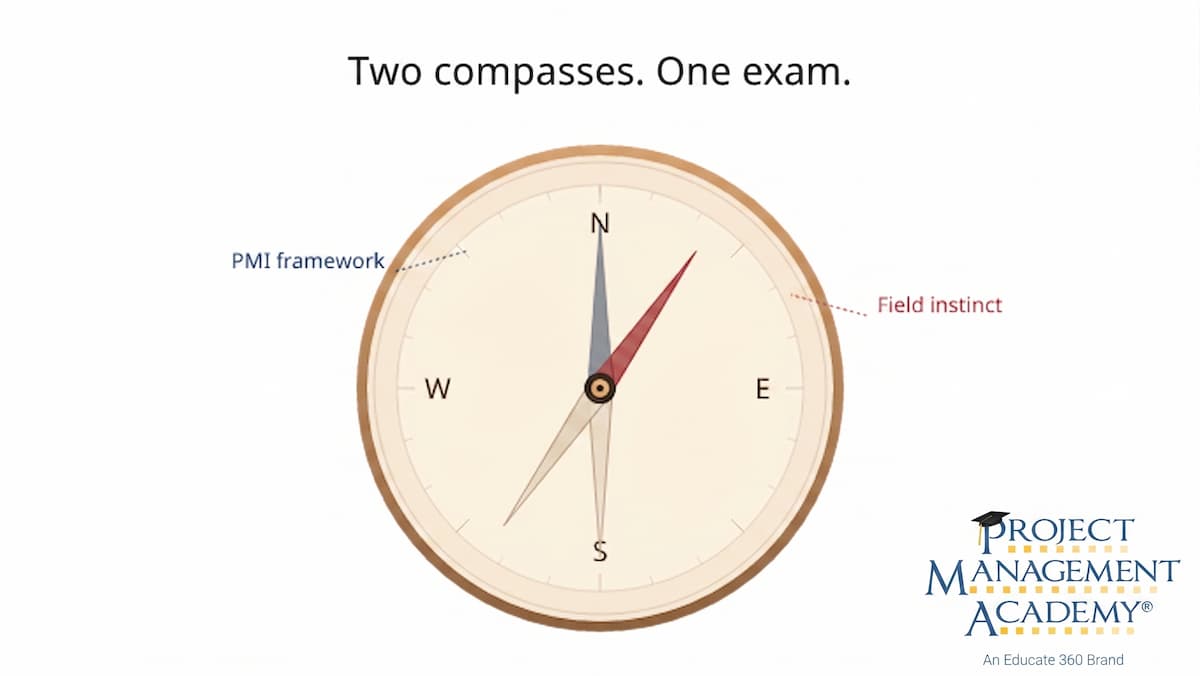
Three Moments Instinct Can Override the PMI Lens
Most PMP questions don’t ask for a single correct answer. They ask for the best one. The difference between the correct answer and a reasonable one is often a single PMI value applied consistently.
There are three moments where experience tends to override the PMI lens. In each one, the instinctive answer feels professionally sound, but PMI’s best answer points somewhere different. Knowing what to watch for lets you catch yourself before you commit.
The three moments where instinct tends to override the PMI lens:
- Answering from experience instead of framework: A scenario feels familiar and you pick the answer that matches what you’ve done before.
- Example: A deliverable has a defect. Your instinct is to fix it and inform the sponsor after. PMI’s approach: assess the impact, log it in the risk register, and communicate with the sponsor before touching the deliverable.
- Treating the exam like a knowledge test: You identify a concept you know and anchor on the technical answer.
- Example: A question references a WBS and asks what to do next. The knowledge-test instinct sequences tasks. The PMI instinct checks stakeholder alignment first.
- Picking the good-enough answer: Two options look valid and you go with the one that feels like the right call.
- Example: A team member raises a concern about project direction. A good answer addresses it. The PMI best answer includes the team member in finding the path forward.
Once you can name these three moments, your preparation becomes targeted. Recognizing the moment is half the work. The other half is training yourself to pause, apply the PMI lens, and choose deliberately instead of instinctively.
Practice the PMI Mindset Before Exam Day
Shifting your mindset doesn’t come from reading PMI’s framework. It comes from internalizing the PMI framework and applying it without hesitation. Before each answer, pause and ask: what would PMI’s ideal PM do here? Not what would I do.
PMI’s exam questions consistently reward four behavioral principles. Understanding them turns answer selection from guesswork into a repeatable decision process.
Four behavioral principles that function as practical exam lenses:
- Proactive communication: When two answers both solve the problem, the one that communicates earlier or more broadly is usually the PMI answer.
- Servant leadership: When a question involves your team, the answer that supports or includes them outranks the one that resolves the issue for them.
- Inclusive decision-making: PMI’s ideal PM brings in the right people before any decision moves forward. Answers that skip that step to move faster are rarely the best answer.
- Ethics-first decision-making: When an answer involves a shortcut or compromise to process integrity, the one that takes the ethical path is the PMI answer, even when it’s slower.
Each principle tells you what to look for, not what to memorize. The more consistently you apply them during practice, the faster they surface when it counts.
Knowing how PMI thinks is one skill. Applying it under time pressure is another. Both sharpen through repetition, not more content review. The right kind of practice builds both.
Train for the Exam in Front of You
Timed practice exams are the most effective way to build the PMI mindset because they replicate the pressure you’ll face on exam day. More content review gives you more to know, not more ability to apply it.
Three exam preparation habits that build the PMI mindset over time:
- Instinct-Driven Flags: When experience overrides framework and you get it wrong, flag it and review it through the behavioral principles lens.
- Start timed practice early: The PMI mindset needs to feel automatic under pressure. Starting timed practice early trains you to recall the PMI lens quickly.
- Wrong Answer Review: Trace each missed question back to the instinct moment that caused it.
These three practices work together. Apply all three throughout your preparation and the PMI mindset becomes a habit before exam day.
One more technique belongs in your exam day routine. Before you begin your exam, take a few moments and write down the four behavioral principles from memory: proactive communication, servant leadership, stakeholder inclusion, and ethics first. Writing them down before the exam begins will remind you of the principles to apply when the questions start.
Experience and Mindset Both Matter
The PMI mindset builds on the project management methods you already use and applies whether you are sitting for the current exam or the updated version on July 9, 2026. It teaches you to apply what you know the way PMI expects it on the exam. Passing candidates aren’t always the most experienced project managers. What separates them is learning to think the way PMI’s ideal PM would.
The cybersecurity professional from the opening eventually passed the CISSP, not by abandoning what they knew, but by learning how the framework wanted them to apply it. The PMI lens and field instincts don’t replace each other. Walk into the exam with both, and you’ll walk out certified.
Project Management Academy’s PMP exam preparation course develops the PMI mindset, not just content knowledge. The course is designed to close the gap between real-world experience and exam-day performance. Whether you’re preparing on your own or your organization is investing in its PM team, PMA has you covered.
Are you preparing for the exam you think you’re taking, or the one you’ll face?
Explore PMA’s PMP Prep Course and start building the mindset that gets you certified.


 Influencing Without Authority
 (877) 637-0450
 contact@projectmanagementacademy.net
 Mon - Fri | 8:00 AM - 6:00 PM EST


 New Horizons
 Project Management Academy
 Velopi
 Six Sigma Online
 TCM Security
 TRACOM
 Watermark Learning