
 New Horizons
 Project Management Academy
 Six Sigma Online
 TCM Security
 TRACOM
 Velopi
 Watermark Learning
 Login
Login



Key Takeaways
- Task Completion Isn’t Enough: Value created by the work defines project success, not tasks completed
- Behaviors to Practice Now: Connecting tasks to outcomes and framing risks in business terms builds value-focused thinking
- Certification Adds Credibility: PMP credentials validate the value-focused habits you build through real project work
Six months into their first real project role, a junior PM was running a tight ship. Meetings started on time, status updates went out on schedule, and the team logged every risk.
Then, after a stakeholder meeting, a senior PM pulled them aside. “You’re managing the work,” they said. “But have you thought about the value it’s supposed to create?” The junior PM wasn’t sure what the difference was.
The Project Management Institute released PMBOK 8 in late 2025, its most significant update in years. Previous editions focused heavily on processes, knowledge areas, and step-by-step execution mechanics. The previous version, PMBOK 7, began shifting the profession toward principles and value delivery.
PMBOK 8 builds on that direction, reorienting project management around value, outcomes, and strategic impact in a way that’s more practical and easier to apply. Three specific behaviors sit at the center of this shift, and PMs who build them into their daily work aren’t keeping up with the profession’s direction. They’re ahead of it.
Task Execution Isn’t the Whole Job Anymore
PMBOK 8 didn’t just refine the project management framework; it also introduced new concepts. Building on the value-focused direction introduced in PMBOK 7, this edition sharpens that shift, making it more practical and easier to apply across all project environments. A PM who finishes every task on schedule but can’t connect the work to a measurable result delivers half of what the role requires.
The gap is measurable. According to PMI’s 2025 Pulse of the Profession report, only 18% of project professionals demonstrate high business acumen, yet those who do outperform peers across every major metric, including lower project failure rates (8% vs. 11%) and significantly higher rates of meeting business objectives.
The framework builds on six core principles: adopt a holistic view, focus on value, embed quality, be an accountable leader, integrate sustainability, and build an empowered culture.
Exam prep doesn’t build this mindset because you can develop it before you ever open a study guide. Three specific habits make this possible.
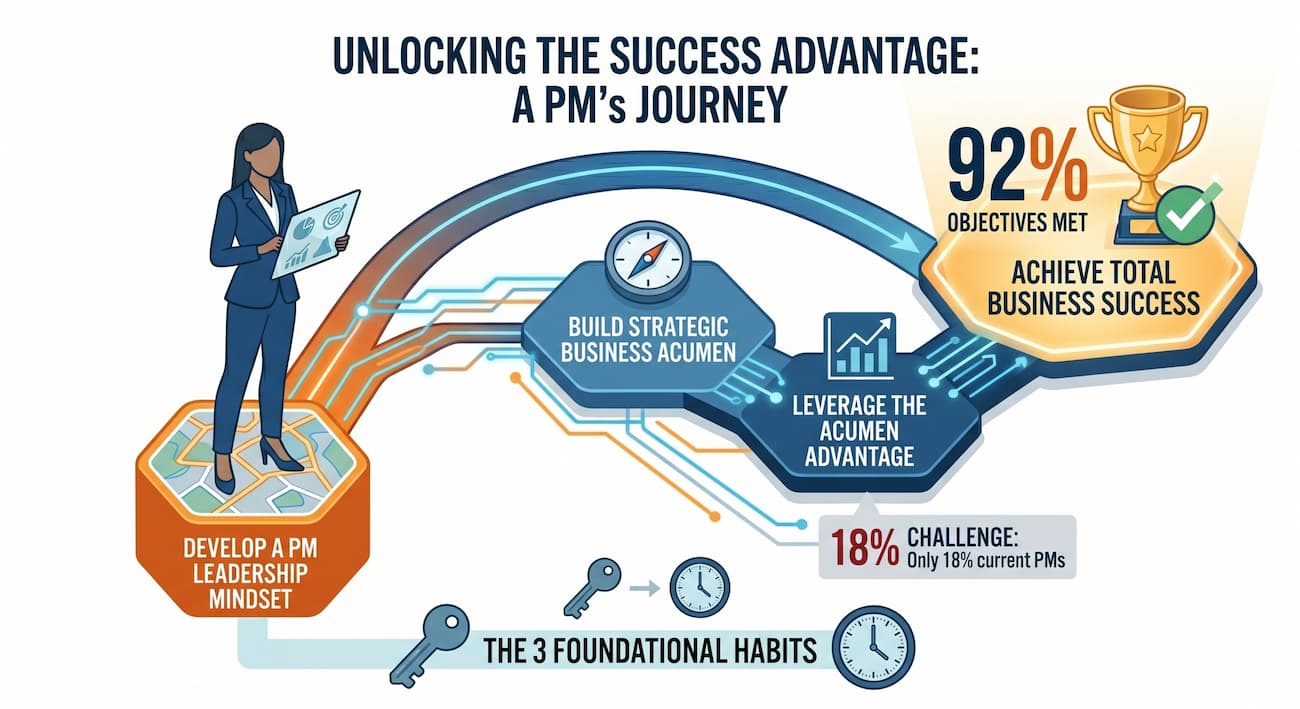
Three Habits That Separate Task Managers from Project Leaders
PMs often know something feels off when they close a project task that didn’t deliver the expected outcome. PMBOK 8 closes that gap by setting a clear standard: connect the work to the value it creates.
The following three habits make the shift possible.
Connecting tasks to outcomes
- Default habit: Mark a task complete when the work product is done
- Value-focused alternative: Note how it connects to a project goal or business need before logging it complete
Real project example: A PM closing out an integration task notes in the status update how it ties to the stakeholder’s go-live milestone, giving the team context rather than just a checkbox.
Framing risks in business terms
- Default habit: Log risks with probability and timeline impact
- Value-focused alternative: Describe what the risk could cost the business, not just how it affects the schedule
Real project example: A vendor delay framed as a threat to a Q3 revenue target, not just a two-week slip, changes the conversation entirely.
Questioning the scope before committing
- Default habit: Receive scope and plan execution
- Value-focused alternative: Ask what outcome the scope intends to produce before accepting it
Real project example: When a feature request comes in mid-project, the conversation stays at the planning level until the outcome is clear. That’s where it belongs.
These three habits reinforce each other. If you’ve pushed back on a timeline or questioned why a task was on the plan, you’ve already started. Consistently following these habits is a choice you can make right now.
Good Habits Don’t Build Themselves
Many PMs plan to develop these habits once they land a bigger role or a more complex project. The ones who advance don’t wait for that to happen. They apply value-focused thinking to the work already in front of them.
Initiative is its own form of professional leadership, and connecting tasks to outcomes, framing risks in business terms, and questioning scope before committing don’t belong only to senior PMs. These behaviors belong in every status update, every risk discussion, and every kickoff meeting for your projects.
Consider a kickoff meeting where a value-focused PM has already asked whether the plan serves the business’ needs. The team spends less time backtracking because the work started with the right question.
These habits also change how a team operates. When a PM consistently connects tasks to outcomes in status updates, the team starts doing the same.
By starting early, you build the mindset before you pursue certification. PMs who move fastest don’t learn this from a study guide. They build these habits with every project they lead.
Prove What You Know
Building the value-focused habits described in PMBOK 8 takes time and real project work. On-the-job experience is essential, but it only takes you so far. Formal credentials add structure, depth, and professional credibility that the work itself can’t provide.
The credential difference is measurable. According to PMI’s Earning Power: Project Management Salary Survey, 14th Edition, PMP-certified professionals in the U.S. earn a median salary of $135,000, compared to $109,157 for non-certified peers, a 24% difference.
Starting early makes exam preparation easier. The PMP exam doesn’t just test what you know; it tests how you think. Starting now puts you a step ahead before you’ve opened a single study guide.
The Mindset Is Yours to Build
Today’s project managers need to think differently about their work. To build this mindset, PMBOK 8 defines six core principles: adopt a holistic view, focus on value, embed quality, be an accountable leader, integrate sustainability, and build an empowered culture. You don’t need a new title or a new job to start practicing them.
Your current project is where this project mindset takes root. PMs who connect tasks to outcomes and frame risks in business terms because the work calls for it are already practicing what the profession is asking for. Every project, every risk conversation, and every scope decision is an opportunity to build on it.
Project Management Academy training builds on your current project management practices, whether you’re early in your career or preparing for your PMP.
Ready to start connecting your work to outcomes that matter?
Explore our project management courses to find the right starting point for where you are right now.
Recommended Training:

 Influencing Without Authority
 (877) 637-0450
 contact@projectmanagementacademy.net
 Mon - Fri | 8:00 AM - 6:00 PM EST


 New Horizons
 Project Management Academy
 Velopi
 Six Sigma Online
 TCM Security
 TRACOM
 Watermark Learning