
 New Horizons
 Project Management Academy
 Six Sigma Online
 TCM Security
 TRACOM
 Velopi
 Watermark Learning
 Login
Login



Key Takeaways
- Action owner vs. decision owner: the person accountable for completing the work isn’t always the person accountable for the verdict.
- Force the verdict: use a simple accept/defer/close model so every finding gets a real decision, not just a status
- Follow up without chasing: two structured check-ins that keep accountability alive without feeling like surveillance
- Multi-team decision vacuum: when a finding crosses department lines, ownership disappears by default and the PM has to name it
- Post-review sequence: five steps that move findings from documented to decided, in the order that keeps accountability intact
The hardest part of a health review isn’t running it. It’s the moment after it ends, when everyone leaves thinking the work is done. The right people were in the room. Real problems came forward. By the time the meeting concluded, everyone agreed on what needed to change. Two weeks later, the project was drifting in the same wrong direction.
When that scenario plays out, the problem isn’t the review. The findings were accurate, the discussion was honest, and the agreement was genuine. A good health review did what it was supposed to do. What failed was everything that happened after everyone left.
Most project management frameworks invest heavily in how to run a good health review: what to measure, how to structure the conversation, and how to document findings. Far less attention goes to what happens once the findings are documented. The assumption is that follow-through takes care of itself. It doesn’t.
PMs know this gap well. You carry accountability for outcomes without the authority to force decisions, especially when those decisions involve people outside your direct team. What follows is a repeatable structure for closing findings before the meeting ends and momentum fades.
Distinguish the Decision Owner from the Action Owner
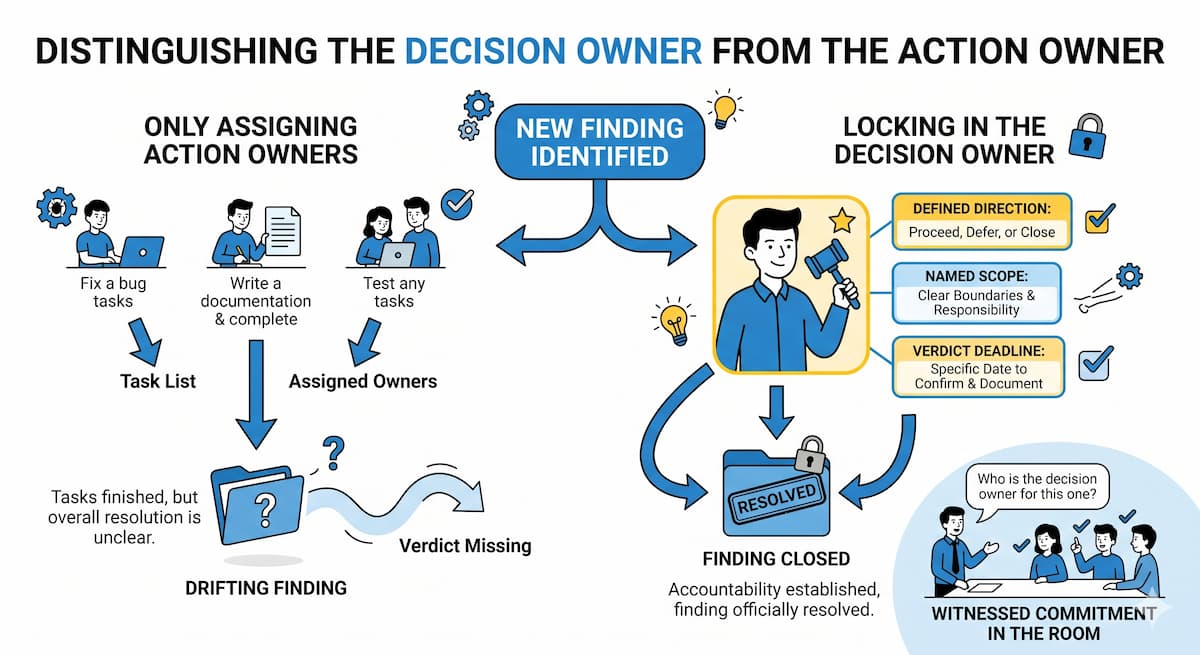
Many teams leave a health review with a task list, but no one is accountable for the verdict. Work gets assigned, owners get named, and the meeting closes with the appearance of resolution. But completing tasks and closing findings aren’t the same thing, and that gap is where accountability disappears.
When the meeting ends without a clear decision owner, findings drift. The difference between a finding that closes and one that doesn’t usually comes down to three things the team locks in before everyone leaves:
- Defined direction: How the team will respond to the finding: proceed, defer, or close
- Named scope: Clear boundaries so the owner knows exactly what they’re accountable for
- Verdict deadline: A specific date by which the owner confirms and documents the verdict
All three have to be in place before anyone leaves the room.
Once authority diffuses and people return to their own priorities, the window for a clean commitment closes fast. Getting all three confirmed in the room is what keeps the window open.
In practice, the conversation is simple. Before the team moves on from any finding, the PM asks, “Who is the decision owner for this one?” Asking it in the room puts the naming in front of the whole team, not just in the follow-up notes. Deflection is harder to sustain face-to-face than it is over email two days later. When the team witnesses the assignment, the commitment carries more weight than anything documented afterward.
Reach a Verdict on Every Finding
Naming a decision owner is the first move. The second is ensuring the person drives the finding to a verdict before the meeting ends. This is where most post-review processes break down. Teams document findings, assign owners, and then watch decisions stall in a gray zone where nothing is formally open or closed.
The fix is a three-state model for verdict language. Every finding reaches one of three outcomes, and nothing else qualifies as a closed status:
- Accepted: the team commits to a specific action, owner, and deadline
- Deferred: addressed by a specific future date, with the reason and revisit date documented
- Closed: not a blocker, no action required, rationale noted
The labels matter because of what they rule out. A finding can’t sit in ”discussed,” “under review,” or ”monitoring.” Each of those is a way of avoiding a verdict rather than reaching one.
Before the team moves on from a finding, a PM should ask: ”Before we move on, is this accepted, deferred, or closed?” The question doesn’t feel procedural when it’s part of the conversation flow. It’s good meeting discipline, and it gives the whole team a shared moment of closure on each finding before the next one opens.
Verdicts don’t just close findings. They change how the team operates after the meeting. When everyone leaves knowing each finding has a status and an owner, the follow-up becomes a matter of honoring a commitment the team already made, not chasing a decision that never fully landed.
Maintain Accountability Without Micromanaging
Once a verdict is documented and an owner is named, the follow-up work begins. This is where PMs often feel the most resistance. Following up on a decision feels like oversight when the decision owner is a peer or a more senior stakeholder. Done wrong, it creates tension. Done right, it keeps everyone accountable to the same outcome without anyone feeling managed.
Everyone involved knows the difference between a compliance check and a verdict confirmation, and the distinction determines whether the conversation feels like shared accountability or oversight.
A two-touch follow-up works well for most findings:
- First check-in (48–72 hours post-review): Confirm the owner has what they need, and nothing has changed the verdict
- Second check-in (at the verdict deadline): Confirm status rather than request an update
Teams that build this cadence into their review cycle stop treating follow-up as oversight. Check-ins become a part of how the group closes its own work.
The language matters less than the framing. When findings cross department lines, the same accountability gap appears at a larger scale, and the structure has to go with it.
Close the Decision Vacuum in Multi-Departmental Reviews
Multi-departmental reviews add a layer of complexity that the standard follow-up approach doesn’t fully cover. When a finding spans two or more teams, no one owns it by default. The people closest to the problem assume someone else will drive it to a verdict, and the decision sits in the gap between departments until the project falters.
Ownership gaps in cross-functional work are structural, not accidental. Individual contributors and team leads are accountable for their own team’s priorities, and a cross-functional finding doesn’t map cleanly to any of them. Without an explicit assignment, it belongs to everyone in theory and no one in practice.
The PM has three specific moves when a finding crosses team lines:
- Assign ownership directly: Name the person with the most direct accountability for the outcome
- Escalate ambiguity as its own finding: Name the gap, assign an owner, and set a deadline
- Document conflicting verdicts: Record both positions and set a deadline for resolution
When department heads understand that unresolved cross-functional findings will be escalated and time-bound, they’re more likely to bring their teams to alignment before the deadline forces the issue. The PM creates the structure. The team leads fill it.
Five Steps That Move Findings from Documented to Decided
Each failure point in the post-review process has a distinct cause. Together the fixes form a sequence, with one addition: when cross-team findings go unresolved, they get escalated as their own finding rather than left open. Each step has one job, and the sequence only works if all five are in place:
- Assign a decision owner per finding before the meeting closes: named person, defined scope, deadline for confirming the verdict
- Drive each finding to a verdict using the three-state model: accepted, deferred, or closed; no other status qualifies
- Document the verdict with the owner’s name and the deadline attached: recordthe direction and timeline, not just the finding
- Follow up at 48–72 hours and at the verdict deadline: two touches framed around shared accountability, not compliance
- Escalate unresolved cross-team findings as their own finding: ambiguity in ownership gets named and treated as a decision gap
The standard is simple: no finding leaves the room without a verdict and an owner.
Maintaining this standard is what keeps a health review from becoming a documentation exercise. The framework gives you the structure to close the gap between what was found and what gets decided, and doing it consistently is what separates a review that generates a list from one that generates change.
The Ten Minutes That Decide Whether Anything Changes
Running a health review isn’t the hard part. It’s the short window between when everyone agrees and when someone is assigned a verdict. Once the window closes, the meeting’s momentum breaks apart into individual to-do lists that compete with everything else already on people’s plates.
PMs operate in this window constantly. Accountability for outcomes falls on them, but the authority to force decisions often doesn’t. This framework gives you structure that makes inaction harder to sustain across the full team, including stakeholders who might otherwise let a finding drift.
Next time you run a health review, measure success by whether each finding has an assigned owner and verdict deadline. The framework doesn’t require forcing every decision. It requires a team that understands why the standard exists in the first place.
Ultimately, you can’t control whether people act. What you can control is whether the decision was ever made. That’s the line between a well-run review and one that changes something, and it’s where the discipline in this framework exists.
Project Management Academy equips professionals with the frameworks and credentials to build the kind of discipline that closes findings, drives verdicts, and holds teams accountable.
Ready to make accountability a standard your whole team keeps?
Partner with Project Management Academy to build the individual skills and team capabilities that turn a good health review into a team standard, not a one-time event.
Recommended Training:
- Problem Solving and Decision Making
- Interpersonal Communication for Project Leaders
- Advanced Project Management Workshop


 Influencing Without Authority
 (877) 637-0450
 contact@projectmanagementacademy.net
 Mon - Fri | 8:00 AM - 6:00 PM EST


 New Horizons
 Project Management Academy
 Velopi
 Six Sigma Online
 TCM Security
 TRACOM
 Watermark Learning