
 New Horizons
 Project Management Academy
 Six Sigma Online
 TCM Security
 TRACOM
 Velopi
 Watermark Learning
 Login
Login



Key Takeaways
- The Output Shift: AI handles the execution work across the project lifecycle, from status reporting to risk logging
- The Judgment Work: Judgment and interpretation are the core of the PM role, driving the calls that determine project outcomes
- CAPM: For PMs with informal experience, establishes the foundational PM framework that makes it verifiable
- PMP: For PMs with deep project experience, certifies the leadership and judgment complex projects demand
- PMI-ACP: For PMs running agile and hybrid delivery, validates the agile facilitation and delivery skills teams rely on
Monday morning. You open your project tool, and the status report is already done. The meeting summary from Friday’s standup is formatted and filed. The risk log updated overnight; a vendor delivery shifted by a week, flagged automatically as medium risk. For a beat, it feels like relief.
Then the question emerges. If AI tools handle everything that used to fill a PM’s morning, what does that mean for their role?
The answer is clearer than it seems. AI is handling the output work now: status drafts, meeting summaries, schedule adjustments, task reminders, reporting dashboards. That frees up the work that requires a PM. The profession is changing because of this, and the PMs who adapt are the ones who recognize what their role requires now.
This holds across every stage of a PM career. Whether an organization is building PM foundations, developing leaders for complex work, or scaling agile delivery, the right credential maps to where their PMs are right now.
The Gap Between Output and Decisions
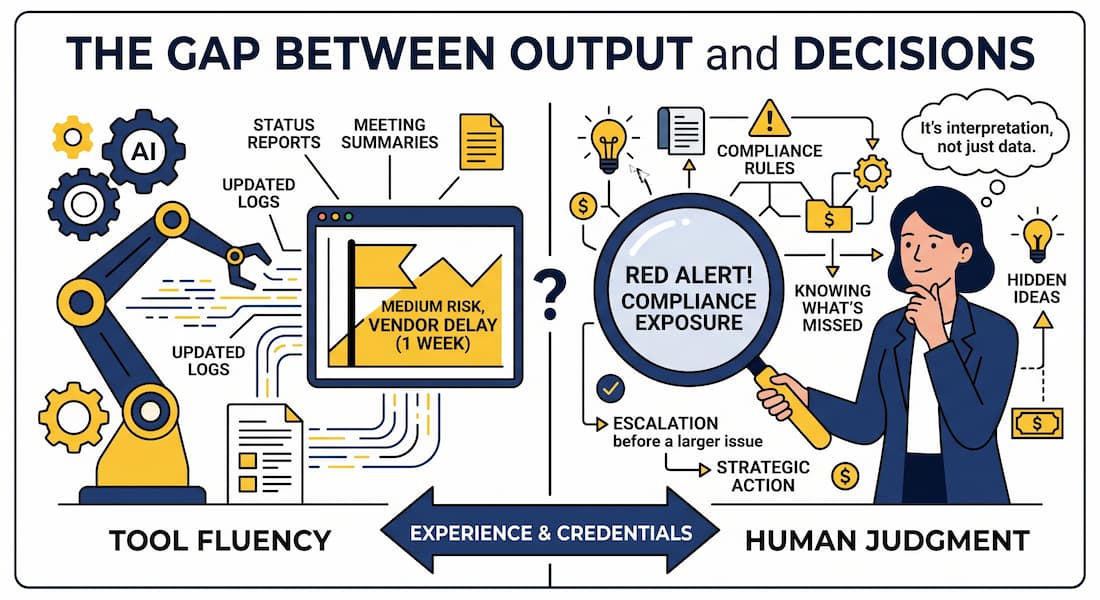
Project management has always had two parts. One part produces the outputs: the reports, the summaries, the updated logs, the formatted deliverables. Judgment is the other part. It’s knowing what the report misses and which green status is about to turn red.
The distinction between output and interpretation is what separates tool fluency from PM competence, and it shows up in concrete ways.
An AI-generated risk log flags a vendor delay as medium risk because the timeline shifted by one week. The flag is accurate as far as the tool can see. An experienced PM recognizes the compliance exposure behind it and takes it to the right people before it becomes a larger issue.
PMI research found that only about 20% of project managers report having extensive or good practical experience with AI tools and technologies, meaning the gap between tool access and demonstrated PM competence is wider than organizations assume.
It shows up in predictable ways. A PM who knows the tool but not the methodology can produce a risk log that looks complete and still miss an exposure the tool never caught. They can run a status meeting that covers every agenda item and leave the real issue unaddressed. PM discipline closes the distance between complete-looking output and a solid decision.
The gap between what the tool produces and what a PM has to know is where credentials become relevant. That knowledge travels across tools, teams, and delivery models. Platform skills don’t. Where a PM is in their career determines which credential closes that gap most effectively.
CAPM Establishes the PM Foundation
For organizations establishing PM foundations, CAPM is an entry-level credential that turns years of informal PM experience into something they can evaluate. Tool access has never been the real differentiator. Discipline has. What organizations need is proof that the PM behind the outputs understands the methodology and structured thinking that makes successful project management repeatable.
The challenge for organizations is that this experience is hard to evaluate. Someone who has been running projects without formal training may handle routine work well but still have significant gaps in their approach to risk, scope control, or stakeholder communication. Those gaps remain hidden until a project gets complicated, and by then the damage is done.
CAPM addresses this directly. For organizations with PMs who’ve been managing projects unofficially, without a formal title or a structured methodology, CAPM formalizes the discipline behind their work. It confirms they understand project management as a repeatable discipline.
Consider what it looks like in practice. A PM managing vendor timelines and cross-functional dependencies for years still hits a scope change mid-project and handles it on instinct. CAPM replaces instinct with structure, giving the PM a clear approach to recognize the right decision, handle it through the right process, and defend their call if it gets questioned.
A recognized credential carries more weight now that AI produces the outputs organizations once used to gauge PM capability. CAPM gives organizations confidence that their PMs understand PMI-aligned frameworks and the methodology driving their decisions, even if they’ve never held a formal PM title.
The PMs organizations should consider for CAPM share a few common attributes:
- Unofficial PM history: Managing projects without the title or formal training, often in ops, IT, or cross-functional roles
- Tool competency without framework: Comfortable with PM software, but without a structured methodology behind the work
- Credential gap: PMs whose experience hasn’t been validated by a recognized certification
A significant share of the PM workforce fits this profile. For organizations with PMs in this profile, CAPM makes that experience verifiable. It puts a recognized structure behind the judgment they’re exercising, and as AI takes on more of the output work, that structure is what organizations rely on to confirm their PMs understand the discipline, not just the tools. For PMs further along in their careers, a different credential applies.
PMP Certifies Leadership and Judgment
For PMs with more experience, the right credential shifts from establishing a foundation to validating the judgment complex projects demand. These PMs lead work across teams and departments, knowing what the data means and who needs to hear it before it becomes a problem. AI now produces the outputs that once required a PM to generate, which makes a credential that reflects their judgment worth more.
PMP is the credential that confirms the leadership, judgment, and delivery ownership those projects require. Every one of those calls requires a person behind it, and the wrong call derails delivery.
Picture what judgment looks like when a project’s scope starts drifting across departments. The status reports stay green, the milestones hold, but an experienced PMP reads the pattern of missed check-ins and escalating change requests as a sign that the business objectives have shifted. Raising the conversation before it derails delivery is the kind of call PMP validates.
PMI’s July 2026 exam update adds context to this. Through a global job task analysis surveying thousands of project practitioners, PMO leaders, and industry experts, PMI rebalanced the exam to put greater weight on business strategy, governance, and adaptive delivery. An update of that scope doesn’t happen without a clear signal that PM responsibilities have evolved. (https://www.pmi.org/certifications/project-management-pmp/new-exam)
The PMs organizations should consider for PMP share a specific profile:
- Experience without external validation: Deep PM history with no formal framework to back it up
- Credential gap at the top: Managing complex, multi-departmental work without a credential that reflects that scope
- AI exposure: Output work getting automated, with judgment and interpretation left undefined
For that group, PMP gives organizations a globally recognized credential that confirms their PMs have the knowledge and capability to lead complex work.
Organizations get the same assurance. PMP confirms that their PMs’ decisions are grounded in a recognized, structured body of knowledge. As AI handles the output work, credentialing the PMs behind it puts a formal framework behind the experience organizations are relying on. For practitioners working in agile and hybrid delivery, the credential question is different.
PMI-ACP Validates Agile Facilitation Expertise
For organizations running agile and hybrid delivery, the output work is shifting fast. Backlog grooming, sprint summaries, ticket drafting, and retrospective documentation are all increasingly handled by AI tools. What that leaves behind is what PMI-ACP certifies.
This shift creates a measurement problem that’s hard to ignore. The facilitation work that determines whether a sprint produces value is difficult to assess from the outside, and AI handling the outputs makes it harder. How a practitioner facilitates under pressure, manages team dynamics, and keeps a sprint useful when requirements shift mid-cycle doesn’t show up in any output the tool produces.
These facilitation skills are what the credential is built around. Servant leadership in the PMI-ACP context means navigating conflict, managing capacity tradeoffs, and keeping ceremonies focused on outcomes rather than process.
Consider what that looks like when a sprint is at risk because two team members can’t agree on scope and the product owner is unavailable. The agile practitioner who keeps the team moving without waiting for escalation is doing that work. Those behaviors determine whether an agile environment produces value or produces process.
The agile practitioners organizations should consider for PMI-ACP share a clear profile:
- Delivery credibility gap: Running agile ceremonies and facilitating complex decisions without a credential that confirms it
- AI-exposed mechanics: Output work getting automated with no clear way to show what their facilitation judgment contributes
- Cross-functional or hybrid scope: Working across predictive and agile delivery modes, needing a credential that spans both
PMI-ACP gives organizations a credible way to evaluate an agile practitioner’s contribution to outcomes, not just process. When practitioners bring certified facilitation judgment to their teams, sprints produce decisions and alignment, not just velocity. For organizations running agile at scale, that’s what turns execution into consistent delivery.
Why Credentials Matter
At every point in a PM career, credentials give organizations a verified baseline of judgment and methodology as AI takes on more of the execution work. When outputs are easier to produce, the need for a clearer way to evaluate PM judgment grows.
AI produces the output, but the PM determines what happens because of it. That’s the work credentials confirm. CAPM, PMP, and PMI-ACP each give organizations a clear line of sight into the capability and delivery performance behind their PM teams, identifying the PMs who can read a situation and stand behind their call.
Project Management Academy partners with organizations to prepare their PMs for CAPM, PMP, and PMI-ACP certification. With instructor-led training, updated exam materials, and support for PMs at every stage of their credential journey, PMA gives them what they need to finish what they start.
Which credentials map to where your project managers are right now? Explore PMA’s certification programs and equip the PMs whose judgment drives your projects forward. Our summer sale is open now.


 Influencing Without Authority
 (877) 637-0450
 contact@projectmanagementacademy.net
 Mon - Fri | 8:00 AM - 6:00 PM EST


 New Horizons
 Project Management Academy
 Velopi
 Six Sigma Online
 TCM Security
 TRACOM
 Watermark Learning